

Why do we so frequently self-sabotage?
The usual answers can’t be accurate. We’re far too good at it for that. Too consistent. Some part of us must be quietly invested in staying stuck. But nobody will say that to our faces.
Aaaaaaactually, come to think of it, I know a guy who would…
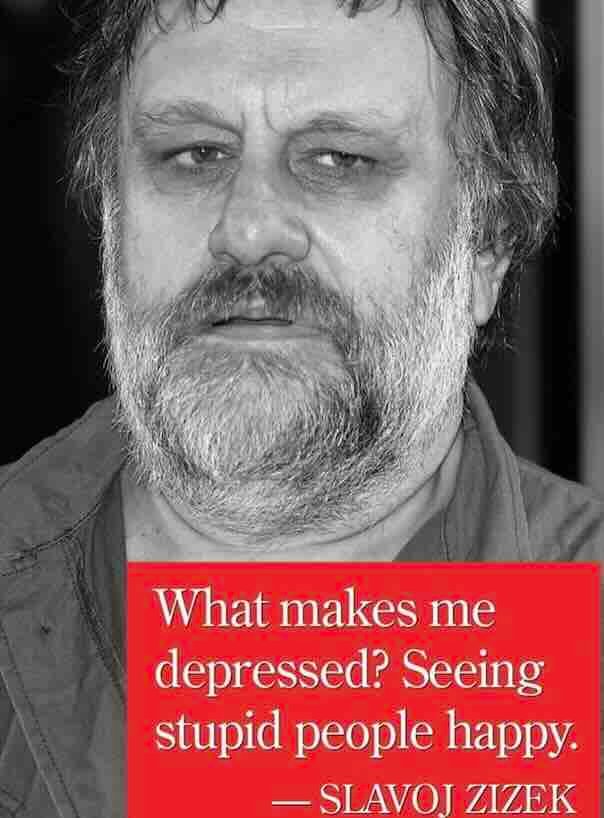
If you saw Slavoj Žižek shuffling through an airport, muttering about ideology and wiping his nose, you wouldn’t say, “There goes someone with practical advice for living.” Seriously, he usually looks like he slept on a bench at the train station.
Ironically, he’s one of the world’s best-known living philosophers, which tells you a lot about philosophy and even more about the world.
Most advice about how to live starts with “You’re a wise, good person who’s been delayed on the way to self-actualization because of blah blah blah.” Žižek starts with the assumption that we don’t even know what we want half the time and are frequently invested in not getting it.
Sounds bleak until you reflect on your own conduct for, oh, ninety seconds.
Žižek says we aren’t unified. We’re not transparent to ourselves. We say one thing, do another, and then rationalize like crazy. We don’t just fail to know ourselves. We actively collaborate in not knowing ourselves. This isn’t the kind of thing you want to hear from a man who looks like he resides in a storm drain.
But we don’t need more false reassurance. We need a brilliant lunatic to point at the machinery of our lives and say: “You see, that part there? (sniffs, rubs nose) This thing you think is normal? That’s where the madness lives.”
And this is why Slavoj Žižek is our most helpful ally against self-sabotage.
Let’s get to it…
Why You Can’t Shake Bad Habits
We know it’s bad but we keep doing it anyway. And we make excuse after excuse for why we don’t stop. But there’s a much simpler explanation: we’re getting something out of it.
Žižek calls this “jouissance,” which is one of those psychoanalytic words that makes you want to blame the French for something. Definition: the ugly thrill embedded in things that are clearly making you worse. The pleasure people take in their own stress, their own martyrdom, the reason we cling to stuff that makes us miserable.
We like to tell ourselves that we’re innocent victims of our circumstances, and we sometimes are. But often there’s a greasy emotional satisfaction in our own misery. Not all misery, obviously. We’re not out here enjoying surprise medical bills. But some forms of suffering come with emotional kickbacks.
The pleasure of outrage. The pleasure of doomscrolling. Some people enjoy being overworked because it makes them feel important. Others enjoy being wounded because they get to be The Noble Victim. We have conflicting desires and we’re not willing to acknowledge the darker ones, so we call the problem “self-sabotage.”
Solution? Ask yourself: what am I getting out of this?
Be willing to acknowledge something less than flattering about yourself. What reward keeps you repeating the pattern? Maybe your stress makes you feel needed. Maybe romantic disappointment gives you the drama you say you hate but secretly love love love.
Being honest with yourself can hurt. But until you have an answer, you can’t fix anything.
(To learn the 4 ways neuroscience can help you quit bad habits, click here.)
Let’s turn our attention to self-sabotage at the office…
Why You’re So Busy But Get So Little Done
Ever wonder why you routinely end the day exhausted but feel like nothing got accomplished?
Because nothing did.
Being “busy” can be a glamorous form of avoidance. If somebody says, “I’ve been so busy,” and can’t identify one thing that’s actually changed, Žižek would say “pseudoactivity” is present.
Pseudoactivity is when you remain in constant motion so you never have to do the one thing that would actually make a difference. You clear inboxes. You rearrange tasks. You download a productivity app to help you stop using your phone, which is like buying a ceremonial dagger to help you quit stabbing yourself. It’s all the stuff that feels like action but is really a defense against action.
So start with the thing that matters. It’s usually the thing that’s scary. Make the phone call. Write the paragraph. Send the email. Sounds small, but it’s the difference between progress and “what the heck did I accomplish today?”
(To learn the six ways neuroscience can make you more productive, click here.)
Time to dig a little deeper and find the “real” you. Or not…
Why It’s So Hard To Find Your “True Self”
We are constantly told to “be our true selves.” This suggests that somewhere beneath our compromises, borrowed desires, family scripts, and embarrassments, there lies a core version of us.
Žižek sees this as one of the most commercially successful fairy tales ever invented.
Seriously, what’s the “core” me? The me that wants to spend all afternoon writing and being a productive citizen? Or the me that wants to eat chips in bed while watching videos about shipwrecks? These are both (unfortunately) me. Those selves aren’t aligned. Those selves wouldn’t carpool together.
The Žižekian answer is: there’s no pure essence waiting to be found. There’s just a mess of drives, roles, identifications, fantasies, obligations, fears, and choices. Which sounds a whole heckuva lot less comforting than the authenticity myth. But it’s actually much more freeing.
Half the paralysis in modern life comes from treating every decision like an existential referendum. “Is this really me?” But if there is no Platonic form of “you,” then you can stop trying to excavate your essence and just begin doing things.
The self-sabotage comes from waiting for inner certainty before taking outer action. Stop looking inward. Start experimenting outward. You don’t discover yourself. You build yourself. You become who you are by acting, committing, failing, and revising.
(To learn the three ways to a better “you,” click here.)
Somehow we even find a way to self-sabotage relaxation. How is that even possible…?
Why It’s So Hard To Relax And Enjoy Yourself
Žižek has this concept of “the superego of enjoyment.” The old moral order basically said, “Deny yourself.” The new order says, “Enjoy yourself.”
And the modern command is so much worse.
You need fulfilling work! Meaningful leisure! Nourishing friendships! Creative hobbies! Inner peace! (I’m getting exhausted just typing this.)
A weekend is no longer just time off. It’s an audition for a life well-lived. You have to maximize it, document it, derive meaning from it. Pleasure is no longer a possibility. It’s homework. You’re no longer merely living; you’re grading your own experience. Was that meal good enough? Was that rest sufficiently restorative? Did I make the most of my Saturday?
Leisure is now something you can fail at.
The self-sabotage is turning pleasure into another performance review. Stop treating every experience like a mining operation for fulfillment. Some days are just fine. Some pleasures are small. Some weekends are boring.
And that’s okay.
(To learn the five rituals that will keep you happy all the time, click here.)
All these tweaks involve change. So why do we self-sabotage that process every time?
Why It’s So Hard To Change Things
We want to be hopeful about the future. And sometimes that’s a terrible idea.
Hope can be the thing keeping us stuck. The hope that says, “Sure, this is bad, but if we stay positive, meaningful change is right around the corner!”
No, it isn’t. Meaningful change is six blocks away, bitter, and refusing to speak to anybody who uses the phrase “just a rough patch.”
Žižek isn’t attacking hope itself, but the false hope that lets you endure humiliating arrangements indefinitely because you’ve convinced yourself they’re transitional.
Maybe the first step is not to feel better about the situation. Maybe the first step is to stop lying about the situation.
Sound harsh? Let’s make it harsher: You’re resilient. And sometimes that is The Worst Thing You Can Be.
Resilience is admirable in the abstract. In practice, it sometimes means training people to withstand conditions that should be intolerable. You are praised for adapting to what should have been stopped.
“The house is on fire, but maybe this is an opportunity for growth.”
No. Stop at “on fire.”
The self-sabotage is using optimism as anesthesia. At some point, you need to accept that things are bad. Not “challenging,” not “in need of dialogue.” Bad. Some systems are not malfunctioning versions of good systems. They are functioning versions of bad ones. Once you accept that, a lot of polite nonsense collapses instantly.
And then you can change.
(To learn how to stop being lazy and get more done, click here.)
And now it’s time for the big one…
Why We Often Fail To Realize Our Dreams
We think fantasy is where we go for a breather when reality gets bad. But Žižek sees it as a much more active and negative force because some of our suffering comes from the fantasy itself, not just from our failure to realize it.
Fantasy isn’t just a mini mental vacation. It tells us what we want, what ought to satisfy us, what shape a life or a success story is supposed to have.
Then reality turns up with all its grocery-store banality and seems defective by comparison. Reality’s always messier, slower, less photogenic, and more annoying than fantasy. Actual relationships involve conflict and weirdness and one person breathing too loud. Fantasy keeps telling you that you’re on the verge of the “real” version, and meanwhile you’re missing the only version you’ll ever get.
Be mindful of what your fantasies are. And stop blaming every real thing for failing to behave like its movie trailer. That alone can save you years of disappointment and at least three unnecessary kitchen renovations.
(To learn the six secrets to motivation, click here.)
Okay, we’ve covered a lot. Let’s round it up, and then deal with one final, very modern form of self-sabotage…
Sum Up
This is how to stop self-sabotaging…
- Why You Can’t Shake Bad Habits: Jouissance is one of those ideas that sounds odd until you notice that it explains half of human behavior. Ask yourself: what am I getting out of this?
- Why You’re So Busy But Get So Little Done: Do the scary thing. The little stuff can wait. That’s why it’s called “little stuff.”
- Why It’s So Hard To Find Your “True Self”: Once you accept that your personality is more like a neighborhood than a single person, everything gets easier and makes a lot more sense.
- Why It’s So Hard To Relax And Enjoy Yourself: Nothing ruins pleasure like the obligation to have it.
- Why It’s So Hard To Change Things: Confront the brutal facts. That’s when your brain stops wasting energy on denial and starts solving. Sometimes the kindest thing isn’t hope, but clarity.
- Why We Often Fail To Realize Our Dreams: Fantasies can make the perfectly decent present feel intolerable.
There’s one last trap, and it may be the most modern one.
All too often we refer to people today with the sterile term “consumers.” But Žižek points out how often we actually don’t consume; we acquire and file.
You subscribe to the newsletter, buy the book, bookmark the essay, download the app, and assemble a watchlist so long that it begins to watch you back. This makes us feel like we’ve already achieved the life we desire. It hasn’t. Owning books isn’t reading. Liking opinions isn’t thinking. Having a gym membership isn’t health.
We simulate participation instead of participating. We outsource living. Žižek calls this “interpassivity.” It gives you the shape of life without the pulse. It lets you feel adjacent to a life without actually having one.
Stop confusing the receipt with the event. Stop collecting the signs of a life and begin the embarrassing business of actually living one. Read one page. Cook one meal. See one friend in actual three-dimensional space. These are small acts, but they have the advantage of occurring in reality, which is where (inconveniently) life is.
Slavoj Žižek is less like a philosopher and more like one of those impolite relatives who notices exactly what everyone else is pretending not to see.
Ask what your bad habits offer you. Stop mistaking being busy for productivity. Stop searching for your “true self” and start doing stuff. Let pleasure just be fun. Admit that the house is on fire. Stop generating fantasies that make the world seem second-rate. Stop collecting the accessories of a life instead of actually living one.
And if a rumpled man at the airport offers to tell you where the real madness lives? Maybe listen to him. He’s the only one not lying to be polite.
