

When delegation goes wrong, leaders usually blame the person they delegated to. They didn’t follow through. They didn’t ask the right questions. They came back with something completely different from what was asked.
But the question worth sitting with first is simpler: what did you actually give them to work with?
If you’ve read “Email Is Harder Than You Think,” you already know that the hard communication work is the part leaders most often skip. It’s far easier to fire off a quick message than to stop and think through what someone actually needs to do the work well. COPP is what doing that hard work looks like in practice.
And DRIP is what you teach your team to give back.
I discussed DRIP briefly in Team Habits, but the DRIP / COPP pair is the full communication handshake. One side gives context. The other side returns work. When both are happening, delegation stops being a gamble.
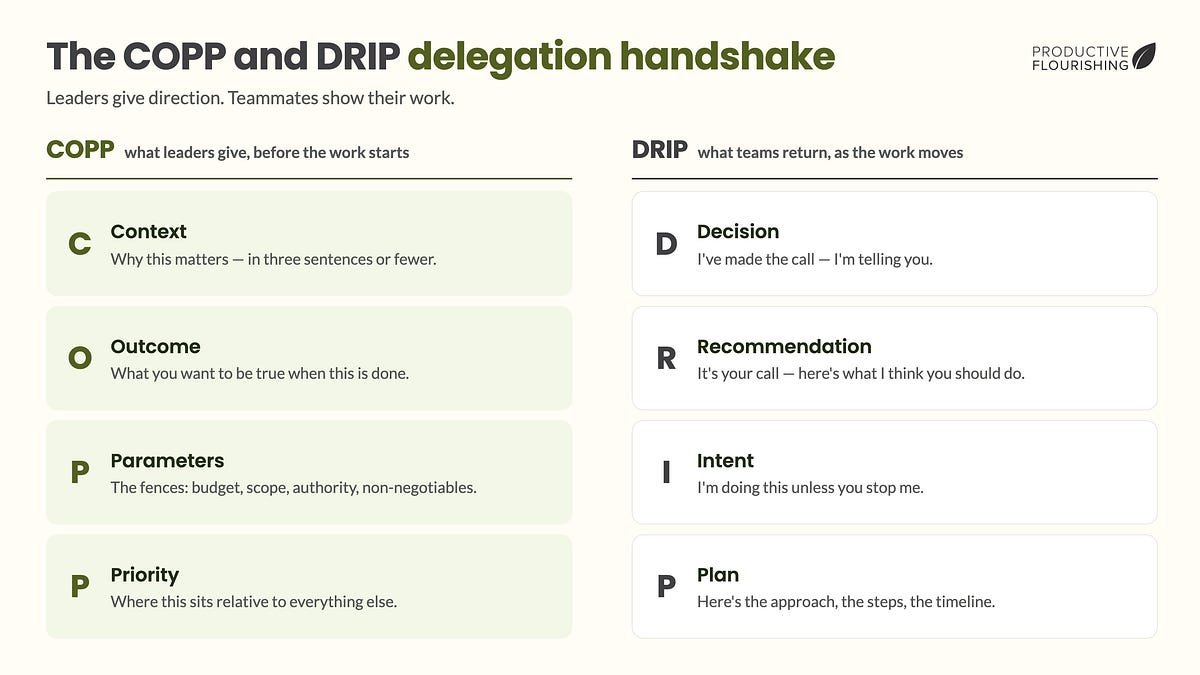
COPP is a framework for what to communicate before you hand something off. It keeps you on the WHAT and WHY side of the handoff and out of the HOW, which helps you avoid the delegation mistake that caps what your team can do at what you can specify. COPP has four components.
Context is the “why this matters,” in three sentences or fewer. Most leaders skip it entirely, which leaves people doing work they don’t understand, for reasons they can’t articulate, with no sense of how it connects to anything else. Three sentences is enough. You’re orienting someone, not writing a brief.
Context is also where vision lives at the task level. I’ve written before that too many leaders confuse having a vision with having a plan, and undershare where things are going because they’re waiting to figure out how they’ll get there. COPP’s context component is the discipline that closes that gap one delegation at a time. You don’t need the full plan to give someone the why.
Outcome is what you actually want to be true when this is done. “Send me a report on Q2 vendor costs” is a task. “I need to understand where we have cost exposure before the board meeting so I can make a case for renegotiating two contracts” is an outcome. One of those gives your team something to aim at. The other just gives them something to do.
You can have multiple outcomes, but the more outcomes you stack in, the more likely you’re going to create harder-to-achieve work scenarios. Be on the lookout for conflicting outcomes, as well, because that’s going to show up in the work.
Parameters are the fences. Budget, scope, authority, constraints, or other non-negotiables tell someone where they can move freely and where they need to stop and ask. Without parameters, people either over-ask for permission on everything or go rogue on something they shouldn’t have. Parameters are how you prevent both.
Priority is where this sits in the stack relative to everything else you’ve already given them. This is the one leaders most reliably omit. If everything is urgent, nothing is. Saying “this is ahead of the vendor review but behind the budget draft” takes ten seconds and saves hours of misaligned effort.
Once you’ve trained this into the culture, “COPP?” is fair for your team to ask if you haven’t given them one — the same turn-any-shortcode-into-a-question move that makes team shortcodes work. It lets people self-advocate for the information they need without it feeling like an accusation.
If COPP is what leaders owe their teams before the work starts, DRIP is what team members owe their leaders as the work moves forward. It’s a forcing function, intentionally so.
DRIP stands for Decision, Recommendation, Intent, and Plan. When a team member brings something to you, they pick one. If your team already knows the three types of decisions, DRIP is the language that pairs with the levels: Level 1 and Level 2 decisions arrive as decisions, intents, or plans, and Level 3 decisions — the ones that are yours, not theirs — arrive as recommendations.
Decision means they’ve already made the call and they’re telling you. They’re telling you because it’s either a Level 2 that they’re taking on or it’s a Level 1 and they’re making the obvious explicit so other folks don’t do the same thinking work.
Recommendation means the decision belongs to you, but they’re bringing you their position anyway. A good teammate never brings a Level 3 decision bare. They can’t make the call, but they can do most of the thinking the call requires and attempt to move work along and remove work from your plate.
Intent is a directional statement given about what they’re going to do. It’s not quite a plan, but also more than a decision. This is intent-based leadership at the working level: the person closest to the work moves, and what flows upward is information, not permission.
Intent is the most underused of the four and arguably the most powerful. It doesn’t require a full plan. It’s a directional signal: “I’m heading this way; let me know if that’s wrong.” Sharing intent early lets work start moving before everything is figured out.
Plan is the intent, fully worked out with the approach, the steps, and the timeline. In teams with higher readiness and trust, plans are usually only a reference for leaders or shown for higher-stakes issues. In these cases, the teammate often just needs to communicate significant dates or components of the plan.
If we looked at DRIP by logical order, it would actually be RDIP, with each letter a step up in how much of the call and work is yours. DRIP is just easier to say and, in fast-moving teams, what’s easier to say sticks and gets used.
Watch out for recommendations that are really a teammate’s decision to move forward on. It could be that they didn’t know it was their decision to make, in which case, it’s a great time to clarify that. Sometimes it’s a teammate passing on the brave work of owning a decision, and if this is the case, you have an expectations conversation ahead of you.
Once you’ve trained your team on DRIP, it’s fair to respond to “what do you think I should do?” with “DRIP?” It means they need to pick one and come back. Done well, it’s an act of respect since it signals that you trust them to have a position and that you’re not going to take part of their job from them. “DRIP?” is a way to build functional trust, even as it may constructively frustrate a teammate into growth or ownership.
This also works best in cultures where people trust that moving forward won’t get them punished for not waiting. If that trust isn’t there, intent will always collapse back into recommendation because asking for permission is safer. Cultures of low trust are getting exactly what they’re set up to get. If that’s where you are, COPP and DRIP are still worth teaching, but they’re building on a foundation that needs its own attention, which is what Lead from Trust and Vision is about.
I’ve been teaching the one-third–two-thirds rule since my Army days: spend no more than one-third of the available time on your own planning and communicating, so your team gets two-thirds of it to execute. Most leaders violate this by waiting until they have a full plan before they say anything. By the time they communicate, there’s not much time left.
COPP makes it possible to hand something off earlier, because the four things someone needs to start moving — context, outcome, parameters, and priority — don’t depend on having a complete plan. You can give those with a rough outline. You don’t need all the answers.
Intent does the same thing on the other side. A team member who can share “here’s my intent, plan to follow” doesn’t have to wait until they’ve figured everything out before they surface. They get more time to develop the full plan. And you get an earlier signal on where things are headed.
Both sides stop waiting on each other, the work starts earlier, and the feedback loops get shorter.
Neither framework works as a solo practice. You can use COPP religiously and still not get clean updates if your team doesn’t know what DRIP is. You can train DRIP into your team and still get back vague work if you’re not giving them useful outcomes and parameters to work with.
The way to introduce both is together, as a team agreement: “Here’s what I commit to giving you before I hand something off. Here’s what I need from you when you bring something to me.” That conversation is itself a trust-building act. You’re making commitments visible, holding both sides to them, and giving your team a shared language for how work moves. When both sides of the handshake are in play, delegation stops being an act of faith and starts being a repeatable process.
Based on what I see in the field, leaders will want to reach for DRIP as the place to start. In reality, though, it’s likely COPP, especially giving concise, actionable context and specific outcomes rather than falling into the process and task weeds. When in doubt, start with COPP.
