

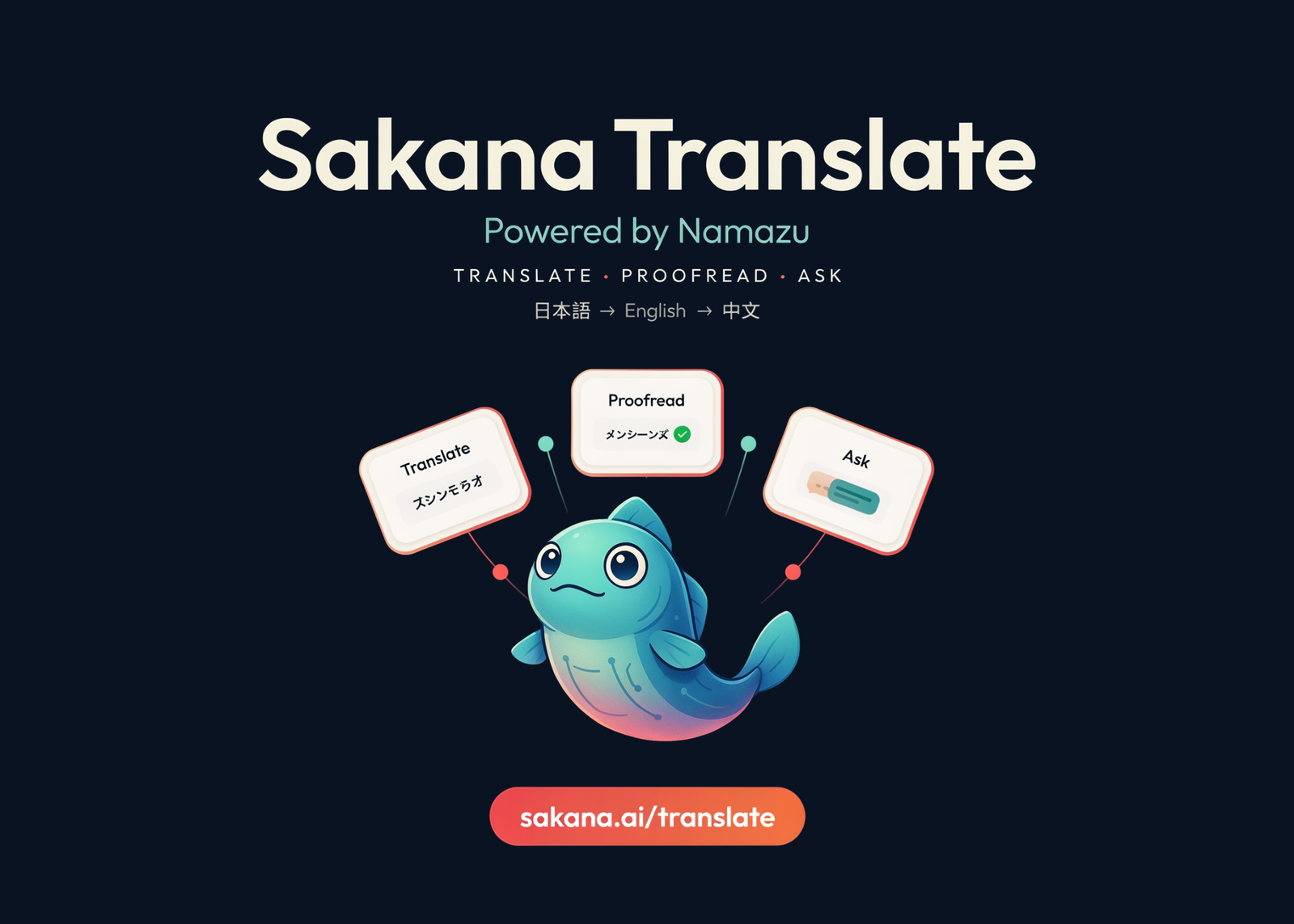
Sakana AI has added a new feature called Sakana Translate to its chat service, Sakana Chat. It handles bidirectional translation across Japanese, English, and Chinese. The translation engine is Namazu, the company’s model series adapted for Japanese.
Sakana Translate ships as a free web app. A single account unlocks all three of its modes.
What is Sakana Translate
Sakana Translate is a browser-based translation product, not a new base model. It runs on Namazu, Sakana AI’s Japan-adapted model series.
The concept Sakana AI states is ‘deep translation for Japan.’ The goal goes beyond swapping words and sentence structures. It aims to carry context, tone, and register between languages.
That focus targets a specific gap. Sakana AI argues that general tools often miss what makes Japanese distinctive. Examples include business honorifics, culturally specific concepts, abbreviations, and internet slang. Grammar may stay correct while interpersonal tone gets lost.
The product bundles three functions into one screen: Translate, Proofread, and Ask.
The Three Modes, Explained
Each mode targets a different everyday task. The table below summarizes them.
ModeWhat it doesKey detailBest forTranslateConverts pasted text between the three languagesUp to ~5,000 Japanese characters, streaming output, history saved automaticallyEmails, slide decks, articles, web pagesProofreadRefines a draft into a more natural versionChanges shown with diff highlighting; adjusts tone, politeness, and formalityBusiness email and English writing checksAskAnswers follow-up questions about a resultClarifies nuance, suggests alternatives, explains grammar in the same contextLearning why a translation reads the way it does
A few terms are worth unpacking for engineers new to this space.
- Streaming output means the translation appears progressively, token by token. You do not wait for the full result before reading. This mirrors how chat models return text.
- Diff highlighting shows exactly what changed. Additions and removals are marked inline, like a version-control diff. Proofread goes past grammar. It also tunes naturalness, politeness, and the register a reader expects.
- Ask removes the tool-switching problem. You no longer jump between a translator and a dictionary. Nuance questions get answered against the same source and output.
You can try all three modes in the interactive demo below
=text.length){clearInterval(timer);if(done)done();resize();}
},14);
}
function matchOut(src){
for(var k in EX){ if(EX[k].src===src.trim()) return EX[k].out; }
return null;
}
var tGo=$(‘#tGo’);
tGo.addEventListener(‘click’,function(){
var src=tIn.value.trim();
if(!src){tOut.textContent=”Enter text or load an example above.”;return;}
var out=matchOut(src);
tGo.disabled=true;
if(out){
stream(tOut,out,function(){tGo.disabled=false;});
}else{
tOut.innerHTML=’This preview streams Sakana AI’s published example pairs. For your own text, use the live engine at translate.sakana.ai.’;
tGo.disabled=false;resize();
}
});
$(‘#tClear’).addEventListener(‘click’,function(){
tIn.value=””;tOut.innerHTML=”;tCount.textContent=”0 / 5,000″;resize();
});
// —- proofread —-
var pDraft=”Thank you for email. I check the document and I think is good. Can you send me the final version by tomorrow? I wait your reply.”;
var pDiffHTML=
‘Thank you for email. Thank you for your email. ‘+
‘I check the document and I think is good. I\u2019ve reviewed the document, and it looks good. ‘+
‘Would you mind sending Can you send me the final version by tomorrow? ‘+
‘I wait your reply. I look forward to your reply.’;
var pIn=$(‘#pIn’),pOut=$(‘#pOut’),pGo=$(‘#pGo’);
all(‘.stx-chip[data-pex]’).forEach(function(c){
c.addEventListener(‘click’,function(){pIn.value=pDraft;pOut.innerHTML=”;resize();});
});
pGo.addEventListener(‘click’,function(){
if(!pIn.value.trim()){pOut.textContent=”Paste a draft, or load the example.”;return;}
if(pIn.value.trim()===pDraft){
pOut.innerHTML=pDiffHTML;
}else{
pOut.innerHTML=’This preview shows one illustrative diff. For live proofreading of your own draft, use translate.sakana.ai.’;
}
resize();
});
$(‘#pClear’).addEventListener(‘click’,function(){pIn.value=””;pOut.innerHTML=”;resize();});
// —- ask —-
var ANS={
a1:’勉手なお願い literally means an “imposing” or “presumptuous” request. In English, “a bit of a selfish request” keeps that self-lowering, apologetic tone. A flatter translation like “I have a request” would drop the politeness the writer signals in Japanese.’,
a2:’A more formal option: “I realize this is an imposition, but might we discuss this a little further?” It raises the register for senior clients while preserving the original meaning and deference.’,
a3:’The source uses business honorific patterns such as 拜見しました (a humble form of “I saw”). The translation stays polite and warm without sounding stiff, matching the writer’s distance from the reader.’
};
var askAns=$(‘#askAns’);
all(‘.stx-qbtn’).forEach(function(b){
b.addEventListener(‘click’,function(){
askAns.style.display=’block’;
askAns.innerHTML=ANS[b.getAttribute(‘data-ans’)];
resize();
});
});
window.addEventListener(‘load’,resize);
window.addEventListener(‘resize’,resize);
setTimeout(resize,120);
})();
