

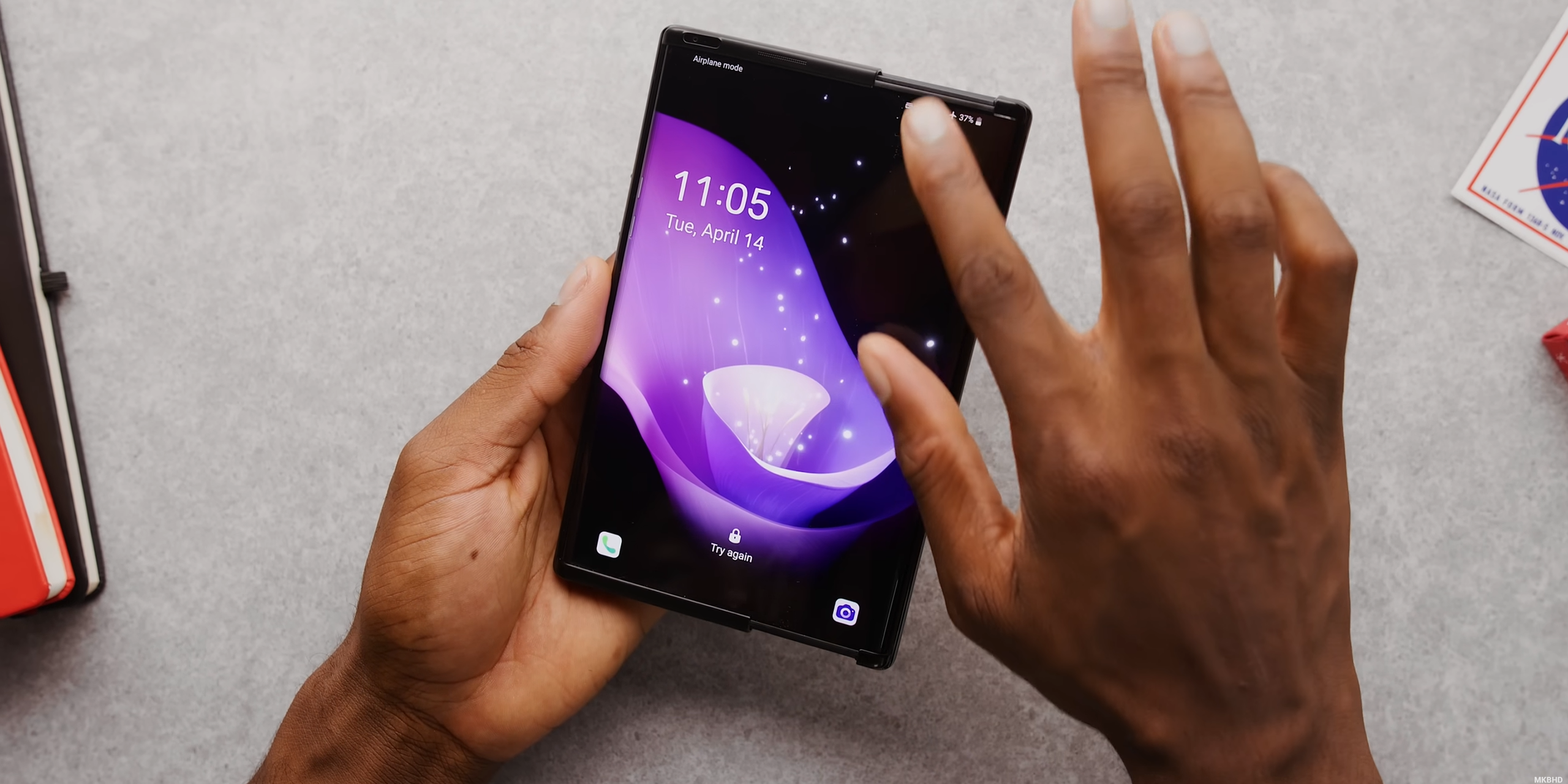
A few years back LG, a company well known for making weird and wacky mobile devices, made waves by revealing its rollable phone concept. The idea behind this phone was to offer a standard smartphone experience, but expand the screen with the push of a button — without hinges or folding mechanisms.
That phone was never released because LG’s mobile division shut down. But more than five years after that unceremonious cancellation, the LG rollable has made its way out into the world, and into the hands of YouTuber Marques Brownlee — A.K.A MKBHD. Naturally, this means he’s just published a video detailing all the rollable secrets we never got to hear about when LG was actively teasing the phone.
The Unreleased Rollable Smartphone! – YouTube
Watch On
Even though this is an older phone now, the smoothness of expanding that 6.7-inch phone screen can expand to a larger, more square-ish 7.3-inch tablet-like display is a sight to behold.
Article continues below
You may like
This is triggered by a three-finger swiping gesture across the screen, and initiates the scrolling mechanism and a little jingle to cover up the sound of the motors. That jingle can be changed, but if you prefer to hear the sound of machinery, the option to switch it off is available.
Interestingly, the extra screen doesn’t live inside the phone and unscroll when needed. It actually wraps around the outside of the phone — offering a secondary display that offers some additional features like widgets or a camera viewfinder.
That last one is particularly important because there doesn’t seem to be a hole-punch camera in the main display. If you want to take selfies, you’re going to have to use the pair of rear-mounted camera lenses instead. Though, considering the hardware difference between rear and front cameras, that isn’t the end of the world.
(Image credit: Marques Brownlee)
The screen itself isn’t entirely crease-free, since there are areas where the display comes under pressure, and Brownlee notes that there is some noticeable signs along the edges. However, he makes it clear that there is a lot less warping than you’d find with a traditional foldable phone.
However, the rollable mechanism does come with some design drawbacks. There are the obvious curved edges on either side of the display, which were all the rage back in 2021. While I happen to despise this particular design choice on regular phones, it’s likely out of necessity here. The wrap-around display wouldn’t happen without a curve, and the extra curve was likely included for symmetry.
Brownlee notes that the motors that control the rolling mechanism are rather strong, and showed the phone pushing a 16-inch MacBook Pro (4.7 lbs) across a table. He also found that squeezing the phone too hard when it’s unrolled will trigger the motors and retract the screen, with an accompanying error message warning you not to do this.
(Image credit: Marques Brownlee)
The actual design of the mechanisms is pretty insane, with JerryrigEverything tearing down the rollable to find two separate motors and rails, accompanied by spring-loaded arms. Clearly, LG had no intention of letting this break accidentally.
What to read next
The phone is also fairly thick, to accommodate all the extra mechanical parts, and that means there’s zero chance this phone is water or dust-resistant. Though since it’s an unreleased prototype, there’s no telling what extra protection would have been included on a hypothetical final model.
The design doesn’t lend itself to physical buttons either. Volume buttons are replaced with touch-sensitive areas on the left side of the phone, while the power button has been mounted on the back beneath the cameras. Like many phones, this power button doubles as a fingerprint sensor, and Brownlee comments that it’s surprisingly reachable. That’s no huge surprise to me, since the old physical fingerprint scanners were considerably easier to reach than their modern, in-display counterparts.
(Image credit: Marques Brownlee)
While we don’t know what LG was planning on calling this phone, or even how much it would cost (my guess is a lot), this prototype does feature a 4,500 mAh battery and 12GB of RAM. So LG wasn’t planning on letting the screen make up for hampered performance.
Overall, I feel that there was potential in a phone like this, and it’s just a shame LG shut down its mobile division before we could actually get our hands on one. But, considering all the rumors surrounding rollable phones and the concepts we’ve seen at shows like CES, I imagine it’s only a matter of time before we actually get the chance to buy one of these ourselves.
Follow Tom’s Guide on Google News and add us as a preferred source to get our up-to-date news, analysis, and reviews in your feeds. Subscribe to Tom’s Guide on YouTube and follow us on TikTok.
