

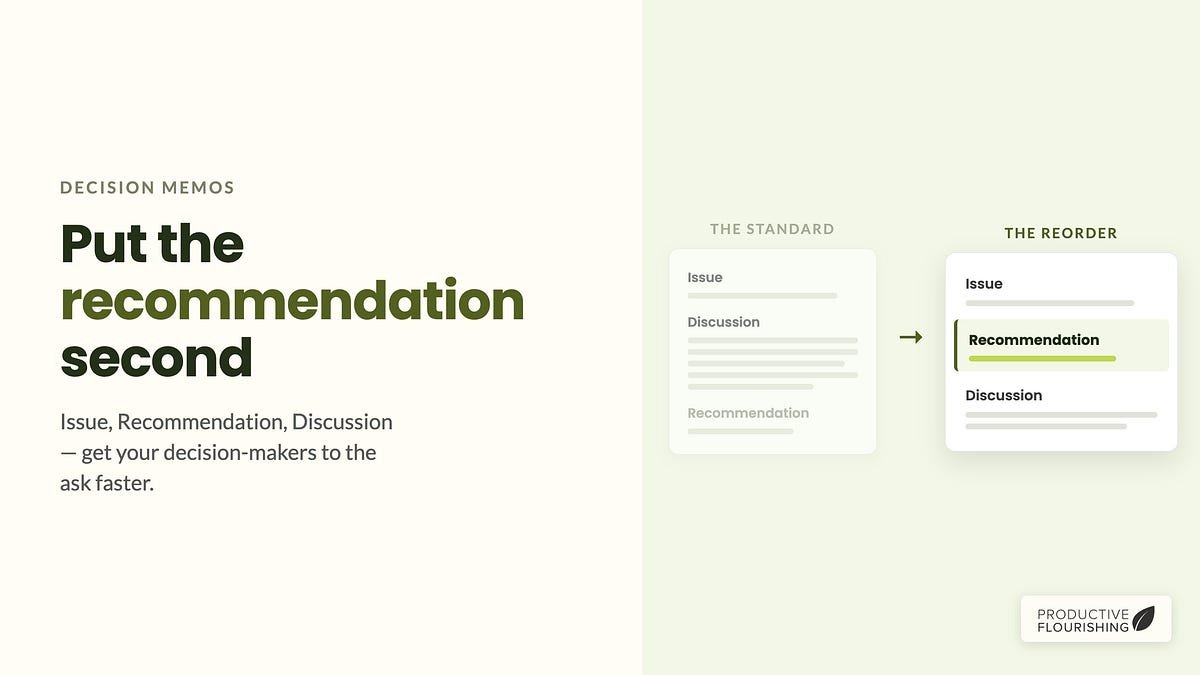
Decision memos to bosses and boards typically follow a standard format: Issue, Discussion, Recommendation. IDR is solid, and it’s the house style of staff colleges, law schools, and policy programs. I teach my clients to reorder it.
Issue, Recommendation, Discussion.
Here’s why. In practice, the recommendation gets buried under seven or eight pages of discussion. Decision-makers take forever to find what’s being asked of them, and discussion-first invites them into the weeds of the decision before they need to be there, debating details instead of championing or approving the broad thrust.
The components carry their own disciplines:
Issue. Statable in two or three sentences. If you can’t state it that tightly, one of three things is wrong: you don’t understand the issue well enough, you’re writing at too low an altitude, or you don’t understand what your decision-makers need to see to decide.
Recommendation. What to do. It goes second.
Discussion. One to two pages, prose or a bulleted summary. Same discipline as the issue: what the decision-makers need to know and no more.
When I teach this, the pushback comes fast: “Don’t I need to build my case first? Isn’t leading with the recommendation abrupt?”
No. A well-written issue and recommendation do much of the case-building on their own, because together they tell your decider what you were considering and optimizing for. The issue opens a gap. The recommendation closes it. The discussion shows how it was closed.
A tight recommendation does something else, too: it shows your decision-makers what blind spots you may have missed, and it lets them introduce parameters you weren’t considering. They can often do that without reading the discussion at all. If you spot trends in what they add, you’ll know what to seed your next recommendations with.
Worried that leading with your recommendation anchors your deciders into rubber-stamping it? It tends to run the other way: a recommendation they can see is one they can push on. The buried recommendation is the one that slides through unexamined.
Consider what burying the recommendation actually costs. Your decision-makers have to wade through pages to find what you’re asking of them, so the memo goes into the “print out and deep thinking” space people pretend they have in their schedules. The response, when it finally comes, is often some version of “So, what are you asking me for?”
The advanced version of the mistake inverts. People who’ve learned to lead with the recommendation sometimes skip the issue, and the recommendation floats unanchored. That response sounds like “Okay, it took me a while to figure out what we were talking about and why it mattered.” Both mistakes produce the same outcome: slower decisions.
Leaders often get queasy about IRD. It can feel presumptuous, as if you’re telling your decision-makers what to decide before you’ve earned the right to. Burying the recommendation is that queasiness expressing itself structurally: discussion-first is an attempt to earn trust on paper. The memo was never going to be the instrument that builds the trust case, though. Operate as if you already have the trust of the people you’re writing to.
If you’re unsure whether your decision-makers would prefer the recommendation or discussion up front, ask them what they’d rather receive. In my experience, the answer is the recommendation up front, every time, because decision-makers look for the ask first and then calibrate how deeply to engage based on the scale of the ask. If your organization mandates a memo template, the reorder still works: put the recommendation in the cover note or executive summary and let the template be the template.
This also explains why IDR remains the standard in large, impersonal organizations: IDR doesn’t rely on trust. The facts and the case are what they are, whoever wrote the memo. If you’re writing to people who know you, though, discussion-first leaves that relationship unused.
The format also works in the other direction. Founders and executives writing to their teams can run the same structure with one change: the R becomes Resolution rather than Recommendation. A recommendation asks someone above you to decide; a resolution tells the people you lead what you’ve decided, and the discussion still shows your work at the altitude they need it.
How is this different from BLUF-ing your memo? Depending on how you write the BLUF, it may be the same thing — a three-sentence BLUF can carry all the relevant information. Typically, though, trying to do that stuffs the BLUF full of discussion items your reader doesn’t need yet. IRD keeps the layers separate so each can do its job.
You already have their trust, or you wouldn’t be the one writing the memo. Write like it.
New to my teaming work? Keep going with the Team Habits Primer.
