

Just dance/Shutterstock
By the early 1950s, externally mounted spare tires sitting above the rear bumper had become a popular fad in automotive design. Unlike other key style traits of the era — such as tail fins, the short-lived wraparound windshields, and copious amounts of chrome — this spare tire setup, known as a Continental kit, provided both form and function. Moving the spare to the rear not only added visual appeal, it freed up valuable trunk space. Automakers ranging from Nash to Cadillac offered options for protruding spares that could add feet to the length of a car. Aftermarket kits also found their way to the market, allowing one to dress up just about any car on the road.
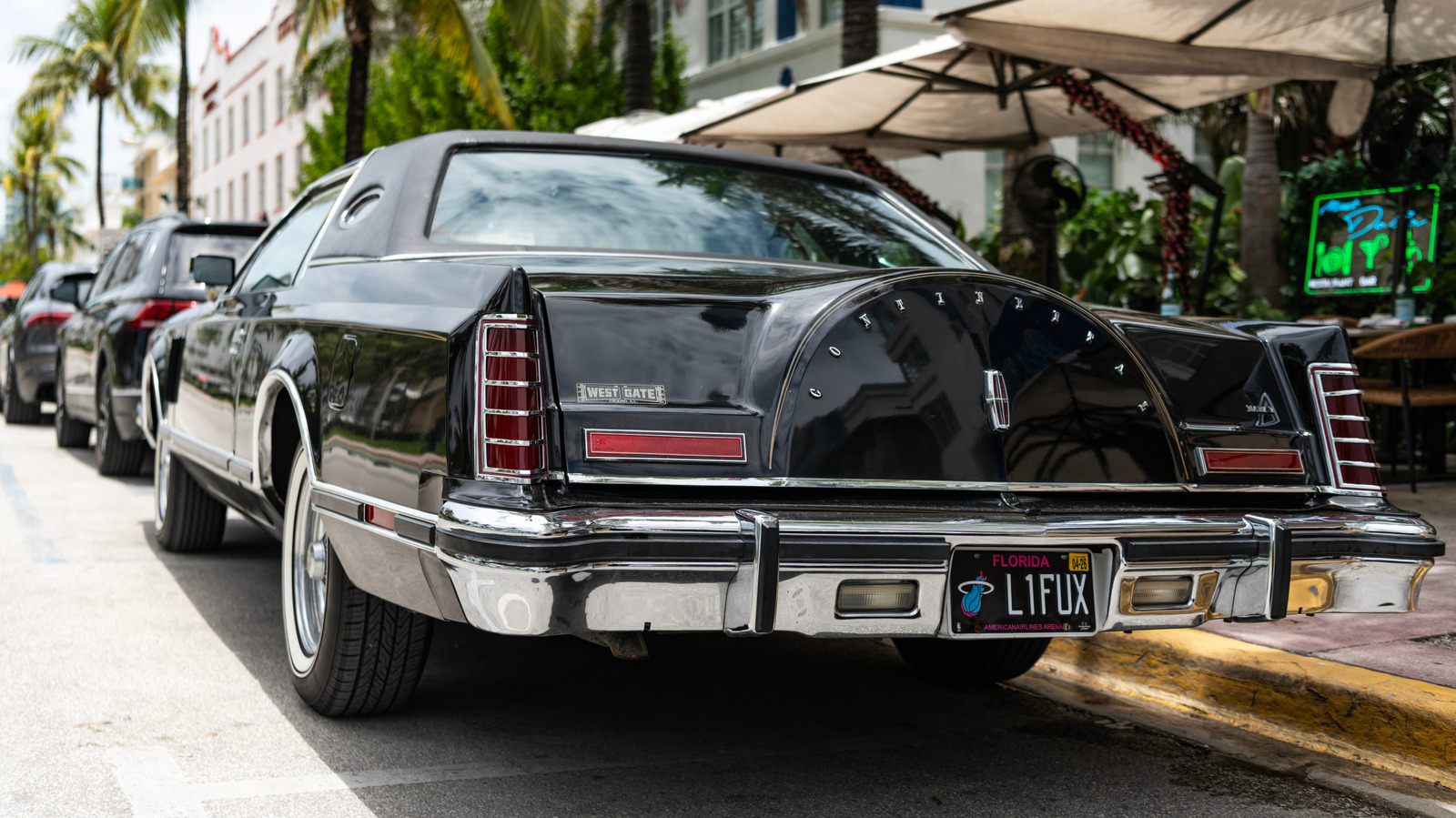
This trend can be traced to the luxurious Lincoln Continental, which sported a purposefully mounted spare tire on the exterior of the trunk. Just as automakers up and down the price chain embraced the style, the second variation of the car that popularized the feature reversed course and bucked it. The Continental Mark II, now sans the Lincoln moniker, hit the street in 1956 having shed the rear spare in favor of a tire-shaped hump in the trunk that concealed the rubber entirely.
Once again, the Continental birthed a new fad: trunk humps. In the following years Chrysler, Packard, and others introduced their own variations, but several of these humps didn’t actually hold a spare; they simply borrowed the appearance of high fashion. As automotive styling evolved and engineers and designers found new places to hide spare tires, the Continental kit became passé. By the early 1960 the look had nearly disappeared. The faux trunk stampings, however, would last into the 1990s before the style finally fell into retirement.
What is the history of the Continental tire kit?
Heritage Images/Getty Images
Edsel Ford, son of Ford Motor Company founder Henry Ford, led the family business as president from 1919 until his death in 1943. While he lacked the ability to make game-changing decisions on his own due to his father’s iron grip on the company, he still influenced significant growth. This included convincing his dad to replace the Ford Model T after 20 years and to purchase Lincoln so Ford could compete with Cadillac — and perhaps exact a bit of revenge. Both Cadillac and Lincoln were founded by one man, with the former rising from the ashes of the failed Henry Ford Company in 1902.
During an early-1930s trip to Europe, Edsel found inspiration in the vehicles he saw. At Edsel’s direction, Ford’s chief designer Eugene T. “Bob” Gregorie built a Euro-inspired sports car based on a 1932 Ford Model 18. A series of one-off customs followed, leading to a 1938 conversation between the duo about building a series production car for Ford’s new mid-priced Mercury line. Another influential trip to Europe saw Edsel delivering design ideas to Gregorie in the form of magazines featuring European cars.
What resulted was the Euro-inspired Continental, crafted from the bones of the V-12 Lincoln Zephyr. The prototype proved so popular that it was put into production as a Lincoln in 1940. A statement of its design was the inset rear-mounted spare tire. While it wasn’t the first to wear a tire back there — spare tires had been mounted on vehicles’ rears for decades prior, after all — it is cited as the first to do so purposefully and seamlessly. When factory and dealership rear-mounted spares became popular in the early 1950s, they were referred to as Continental kits. The name stuck, but the style didn’t.
Why did Continental tire kits turn into humps and disappear?
With the introduction of the Continental Mark II and its trunk hump in 1956, the visible-spare-tire craze began to wind down. A primary aspect of this was evolving automotive styling, leading to the near disappearance of the kits by the middle of the 1960s. Another reason that led to their demise: general impracticability. To make access to the trunk of a vehicle with a Continental kit convenient, automakers had to overengineer the setup to make the whole apparatus swing or roll out of the way. If the car had a stationary kit, one would have to load their groceries and luggage over the tire hump.
Where did the spare tires go? For many automakers, the trunk made the most sense, with tires placed in a recessed well or stored vertically to one side or the other. And these days, some new cars don’t include a spare tire anymore.
Despite the changing times, the Lincoln Continental Mark series could not shake the hump it had created. When the Continental Mark III arrived for 1968, it sported the infamous faux tire bump for the first time since 1957, an element of the design insisted upon by Lee Iacocca. The signature style would live on for five more generations. The last in the lineage, the 1993 to 1998 Mark VIII received a subtle arch in the trunk lid to represent the once enthralling mark of luxury car design.
