

Ah, depreciation. For the new-car shopper, it’s a curse, a hidden force that can eat away at the value of your exciting purchase from the very first minute you step inside it. Some cars lose over 25% of their initial value in the first year, and then go on to lose more than 60% after just five years on the road. It certainly takes a bit of the shine off new-car ownership, but that shine redirects onto the used-car market, where bargains can be found.
Naturally, if a new car sheds 50% of its value, that equates to a car that can be had for half-off on the used market. Sure, you’ll have to put up with some wear and tear from thousands of miles on the road, but if you don’t have a problem with a car that’s lost its shiny new smell, your bank balance will be all the better for it.
That’s the initial reaction, at least. See, a new car also comes with a comprehensive warranty, and perhaps even a service plan to ensure everything stays in top shape. Once the warranty period is over, then repairs and failures come down to you, in addition to maintenance, which only gets more involved as a car ages. So while the used car might be cheaper up front, looking after it is a whole other ordeal.
Here are five cars that have been hit harder than most by the depreciation stick, meaning they can look like relative bargains. However, keeping any of them running will demand you dip deep into your wallet, diluting their appeal.
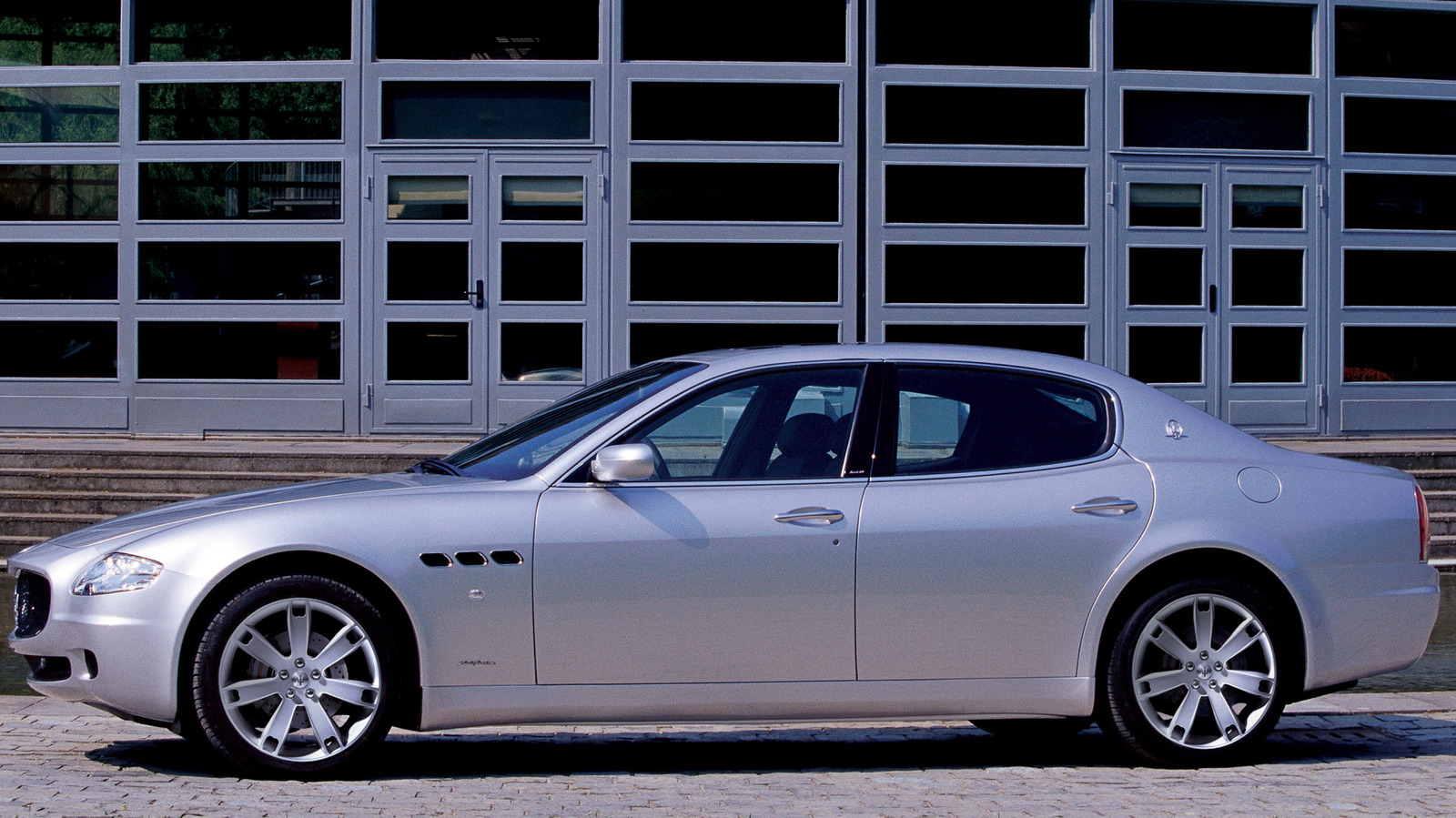
Maserati Quattroporte
There’s no need to be overly specific here and start highlighting particular model years. All iterations of the modern Quattroporte, built from 2003 onward, have been subjected to much in the way of depreciation, and so these mighty Italians can seem like tempting bargains. According to CarEdge, the typical Quattroporte will lose (get ready for it) 72% of its initial value after just five years on the road. Seventy-two!
So if you purchased a last-of-the-line Quattroporte Ultima in 2024, for $140,995, and then rocked it for five years, covering a rather average 12,000 miles per year or so, you’d be looking at a resale value of just $39,479. Folks, check in on your Maserati-owning pals — they might not be holding up so great.
You can see why that would be tempting; it’s essentially a $100,000-off voucher for putting up with a 50,000- or 60,000-mile odometer reading. It nets you a punchy V6 or V8 power train, immaculate leather-trimmed cabin, and more features than we care to list. Be prepared, though, because these luxury sedans have their issues when it comes to maintenance costs.
Enthusiasts say to watch out for cold-start rattles on V8 models that may require expensive overhauls to properly correct, to the tune of $5,000 to $10,000. In addition, owners warn that the early DuoSelect gearboxes tend to consume clutches every 30,000 miles or so, and that another $5,000 will be commanded for a repair — not ideal if you want one as a daily driver. That could be $2,500 per annum on clutches alone.
Volkswagen Phaeton W12
So the exotic Italian is a little scary to look after, but that’s probably a little obvious. After all, if you buy something with a Maserati badge expecting Camry running costs, that’s on you. Perhaps go a more sensible route, and buy an executive sedan from Volkswagen instead. What could possibly go wrong?
As it happens, everything. Especially if the executive model in question is a twin-turbocharged 6.0-liter W12-powered Phaeton. When new over two decades ago, these Volkswagens commanded asking prices in the region of $85,000. Today, though, you can pick one up in good order for little over $6,000. Now that’s depreciation.
You might think a cheap Phaeton W12 is your ticket to bargain luxury, and it could be, but beware the scary maintenance costs. Even typically regular jobs attract exotic-level costs due to how tightly packaged the engine is under the hood; enthusiasts warn that virtually everything is an engine-out job. Changing an oxygen sensor, for example, requires the mighty W12 to evacuate its home.
And there’s plenty more to look out for. The air suspension system can be troublesome, the cabin can easily flood if the scuttle channels are blocked, and the various electronic control units can easily become damaged, taking various features with them. Oh, and it takes 12.5 quarts of oil, so even regular servicing will be pricey enough to make you wince. Perhaps just stick with a Passat?
BMW 7 Series
The BMW 7 Series has long been a more driver-oriented alternative to the Mercedes Benz S-Class, so for keen drivers who enjoy a life of luxury, it can make for a tempting proposition on the used-car market. The nameplate has been doing the rounds for decades now, so we’ll ignore the swanky E23, E32 and E38 generations, and instead focus on Bangle-Butt-forward iterations.
Here, you get everything you’d expect from a flagship Bavarian luxury sedan; large engines, miles of leather, heaps of features, and sumptuous comfort. While prices for new models are suitably steep –- a 2026 base model will set you back $99,300 at the very least, prior to a $1,550 destination fee — a used one is laughably cheap in comparison. Kelley Blue Book suggests that an early F01 model (that’s a 2008 Model Year example for those that don’t speak code) can be picked up for less than $5,000, but maintenance costs aren’t similarly low.
For example, The Drive reports that a replacement fuel pump for the V12-powered 760i could set owners back a minimum of $12,000. Insane, considering the cars themselves can be picked up for virtually the same price. In other words, you may as well just buy a replacement BMW with a working fuel pump, instead of just swapping the part out for a new one.
CarEdge says a 7 Series on average will require $15,195 in repair costs throughout the first 10 years of its life, which is $5,505 more than the average car of its segment. Oh, and that’s for an entry-level 740, so use your imagination for the bills if you buy a 750 or 760.
Audi S8
The Volkswagen Phaeton and Audi A8 share the D1 platform, so if one’s pricey to maintain, the other will be, too. The A8 was also available with the mighty W12 engine, but if splashing cash on maintenance is what you’re after, then look past even this, and instead opt for the performance-oriented S8.
It’s possible to pick up an old Audi S8 for around $15,000, and on the face of things, that might seem like an incredible bargain. Yes, it will be furnished with all the luxurious trimmings you might expect to find, but the S8 is also equipped with a naturally aspirated 5.2-liter V10. To speed through some key specifications, that’s 450 horsepower, 398 pound-feet of torque, and a 0-60 time that just dips beneath 5 seconds. When new, you’d have shelled out around $100,000 for the privilege of taking such a car home, but today, some higher-mileage examples trade hands for under a tenth of that.
To state the obvious, keeping a near-two-decade-old, V10-powered, flagship luxury sedan from Audi in top condition requires a significant ongoing financial commitment. RepairPal provides an annual maintenance and repair estimate of $1,726, while CarEdge suggests a figure north of $11,000 would be spent on such bills in the first decade of ownership alone, let alone 20 years down the road. Sure, it’s easy to see why a sub-$10,000 V10 luxury sedan would be tempting, but be sure to do your research before getting hold of one, and maybe pre-warn your mechanic, too.
Range Rover SVR
No list of depreciated luxury hacks with life-ruining maintenance bills is complete without a Range Rover, and while all iterations have the potential to bring a tear to your eye, we’ve thrown in the full-fat SVR performance model. Introduced around 10 years ago, the supercharged 5.0-liter SVR hasn’t had an awful lot of time to depreciate yet, but older and leggier examples can be picked up for just north of $20,000 — roughly $90,000 less than what a new one would have cost.
Needless to say by now, there are numerous reasons why buying a V8 Range Rover for the price of a Nissan Versa isn’t the brightest idea. Much like some of our aforementioned models, working on the SVR can be a little tricky. According to enthusiasts, the main issues to watch out for are timing chains, which become slack over time, and hidden coolant pipes which can quickly fail, leading to overheating issues in a matter of seconds.
Aside from the elevated maintenance costs associated with Range Rovers, insurance and running costs are also among the highest out there. CarEdge places insurance costs north of $5,000 on average, almost $2,000 more than similar models in the sector, while it doesn’t take a genius to work out fueling the 5.0-liter supercharged lump will also require something of a commitment.
