

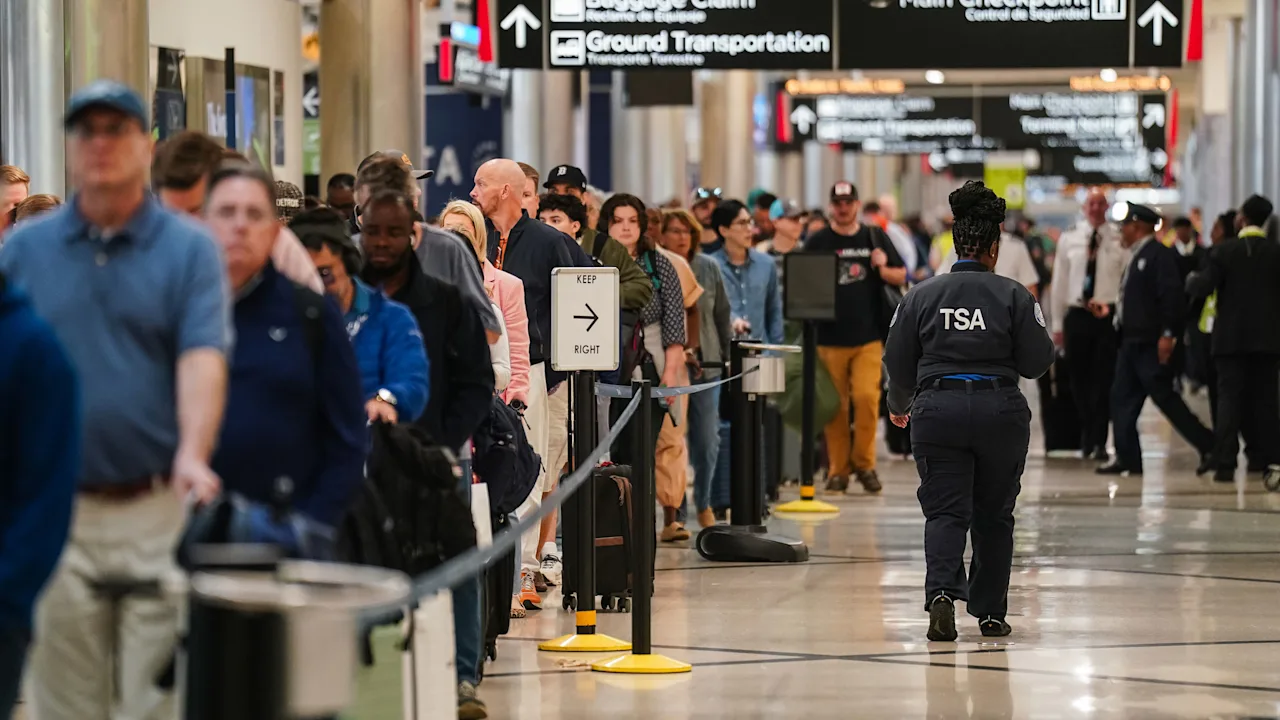
Amid the partial government shutdown, at least 61,000 Transportation Security Administration (TSA) agents are going without pay. Regardless, the employees, who are considered essential workers, have to continue showing up to work. And over 3,000 of them—over 10% of the total agency—aren’t showing up to work at all.
The situation has caused major financial strain for agents who work in an already demanding job that doesn’t seem to have a safety net. Now, they’re caught in the middle of a political battle that’s caused historic chaos and dysfunction in airports across the country: Terminals are standing room only, with security lines snaking their way through multiple floors of the building, and passengers waiting for hours.
When essential workers get pushed to the brink—supermarket staff during the pandemic and service staff facing abuse during the holiday season—it exacerbates the challenges they already face, including low pay and difficult working conditions. These jobs are hard to begin with. Now, the system is being stretched, and it’s a complete disaster—harming the workers and the rest of us, too.
Financial nightmare for agents
Most TSA agents are living paycheck to paycheck. According to a 2026 TSA Pay Scale fact sheet, some entry-level positions start at $34,454 a year, before bonuses or locality adjustments. The average salary range for agents is $46,000 to $55,000, with adjustments based on location. That means most TSA agents earn well below the national average salary of $66,622.
It’s an unfortunate reality that affects many essential workers—who are also historically overworked and underpaid. As bills pile up, some agents have to rely on food banks and donations—a third of TSA workers in Indiana are doing so.
This isn’t the first time in recent months that agents have gone without pay. TSA paychecks were held up for 43 days last fall during the longest government shutdown in history, as well as for several days earlier this year.
At present, at least 400 agents have been forced to turn in their resignations amid the shutdown. Call-out rates have doubled, and at some airports, like Baltimore/Washington International Thurgood Marshall Airport, the call-out rate has soared to over 11%. The missing TSA and airport employees have hardly gone unnoticed: Hours-long lines have led to missed flights and chaotic scenes, and in New York there was a tragic collision with two fatalities that has stoked even more concerns about public safety.
Caught in a political battle
While the Department of Homeland Security (DHS) has been routinely blaming Democrats for the ongoing shutdown, Democrats are in turn calling out the fact that Republicans have blocked legislation to fund TSA employees’ pay eight times. Before the most recent vote took place, Sen. Chuck Schumer took to X to vent frustrations about the consistently blocked bills Democrats have proposed: “Instead of sending ICE agents to harass travelers at airports, why don’t Republicans get their act together and agree to pay TSA workers like we’ve asked them to SEVEN TIMES now?” Schumer wrote on Sunday.
Similarly, on Monday, Sen. Cory Booker called out President Donald Trump’s “inability to simply fund the TSA” in scathing remarks at Newark Liberty International Airport. “We are in a national crisis by Donald Trump’s making,” Booker said.
As TSA workers go without pay and airports are alerting fliers of the need to arrive three hours early, President Trump isn’t calling for Republicans to make a deal to bring an end to the shutdown. Instead, he’s insisting that they don’t bend until his SAVE Act—which would require individuals to provide proof of U.S. citizenship when registering to vote in federal elections—is passed.
“Don’t make any deal on anything unless you include voter ID,” Trump said on Monday.
With no end to the shutdown in sight, Trump announced that Immigration and Customs Enforcement (ICE) would be deployed at airports across the country. Tom Homan, the U.S. border security chief, told CNN on Monday that ICE agents would be helping to get airport lines moving, despite not having gone through the same training that TSA agents receive. “There are roles we can play to release TSA officers from the nonsignificant roles, such as guarding an exit, so they can get back to the scanning machines and move people quicker,” Homan said.
But now, we’re seeing an already underpaid group of essential workers become straight-up unpaid.
A thankless job
The current political dysfunction that’s led to the current situation aside—as well as the financial challenges—TSA agents are already up against a lot.
Being an agent not only involves standing for long periods of time, but staying vigilant in a high-stress environment that’s often a target for public scrutiny. According to the American Federation of Government Employees (AFGE) union, TSA jobs have higher rates of injury than other jobs within the federal government, particularly when dealing with violent passengers. Likewise, the agency has high rates of turnover, even under normal circumstances: Per a 2019 report, nearly one-fifth of new TSA hires had quit within their first six months on the job.
And while many travelers stuck in airports this week are calling for TSA agents to be treated fairly and be paid so that they can resume work, the government agency is not new to controversy. It’s been criticized in the past for being invasive with pat-downs and body scanners, for security measures that provide an illusion of safety rather than real protection, and for profiling passengers. Last year, a Virginia agent issued a lawsuit over a policy that bars transgender agents from conducting pat-downs.
Still, experts say that leaving TSA agents without pay is creating dire circumstances, both for agents and travelers—they screen millions of bags daily and serve as crucial safety staff. Melissa Franks, a business leader and founder of On Call COO, tells Fast Company that defunding the TSA sends the message “that we, as a collective populace, don’t value our safety.”
She adds: “When individuals are not paid a fair living wage for the work they are doing, their lives and the lives of their families are in jeopardy. At best, we have a stressed, exhausted security agency. At worst, we have people who are desperate.”
A fight for TSA safeguards
Amid the ongoing struggles for airport workers, some are hoping to reform the TSA entirely.
Last year, The Reason Foundation, a public policy research platform, developed draft legislation to address a number of issues that impact TSA workers, such as what happens during a government shutdown. The legislation is meant to “insulate” the TSA from “congressional bickering and government shutdown risk.” The foundation’s senior transportation policy analyst, Marc Scribner, told Fast Company that the reform is desperately needed.
“Crowding in the prescreening area of an airport is a major security hazard, and bad actors have exploited these conditions in the past, such as in Brussels and Istanbul in 2016,” Scribner explains. “The current situation with TSA is impossible in most countries. Congress should consider reforms that align with global best practices, such as giving airports the authority to contract with TSA-regulated security providers.”
Regardless of what happens in the future, it’s clear that agents need to be paid right now. Franks says that getting agents their checks is of the utmost importance.
“The most important thing we can do today is pass a bipartisan bill to fund TSA,” Franks says. “Protect and reinstate national security at our airports, and provide the brave agents in the TSA organization with the peace of mind that they can feed and house their families.”
