

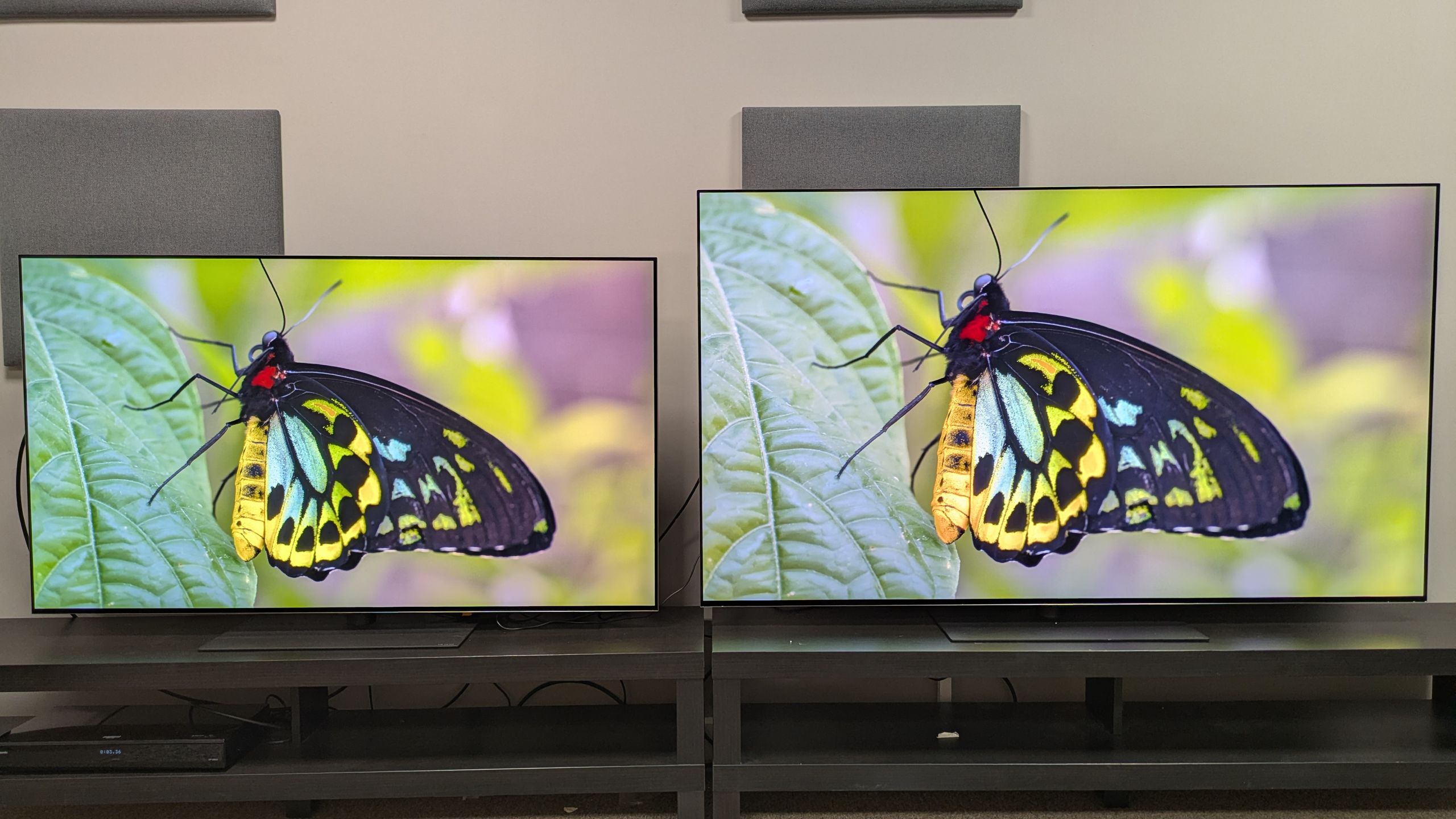
The LG G5 was one of the best-performing TVs of 2025, delivering exceptional picture quality and performance that set a strong bar for the best OLED TVs to follow. The G5 was an excellent flagship OLED, so it meant its successor, the LG G6, needs to prove itself against its predecessor.
I actually already compared the LG G6 side-by-side with the LG G5 once, and was impressed with the results of the G6. It proved to have more natural colors, more accurate contrast with deeper blacks, and proved to be better in bright rooms, thanks to its superior reflection handling. It also posted impressive brightness boosts, especially in fullscreen.
However, since then, LG has released a new firmware update for the G6, which it says makes adjustments to brightness. The color vibrancy had already been adjusted in the G6’s Filmmaker Mode (compared to the G5’s) after feedback. Now, it seems the G6 has had its overall brightness tweaked freshly. So, I applied the update to see what it had done and re-evaluate the G5 and G6 side-by-side again.
Article continues below
You may like
I haven’t written about black levels, shadow detail or sound comparisons here — I wrote about them in my original article, but these remained essentially unchanged, so for my thoughts on these, check out my original article here.
Changes from the firmware update
Some peak areas on the G5 (left) appear particularly bright, whereas they appear more muted on the G6 (right) (Image credit: Future)
Rather than go into too much detail about the firmware updates changes, I’ll give a brief summary here. First and foremost, I found that perceived brightness had been reduced in the G6.
Colors were already more natural on the G6, but again the brightness of said colors on the G6 has been toned down, to give an even more balanced look. In some scenes however, the G6’s colors had more depth and richness. I’ll get into what colors looked like on the G6 shortly.
Some of the major changes came in my objective measurements. While there were minute brightness increases in SDR, the major change came in HDR Filmmaker Mode. I’d measured HDR brightness on a 2% window at 3,326 nits before the update. Post-update, this had dropped to 2,504 nits. While this may seem odd, this is in-line with the brightness limiting I’d expected, to improve tonal accuracy across the range.
These EOTF graphs show that the LG G6 (right) is more accurate at low brightness, being closer to the yellow line — but at higher brightness, it appears to be a little darker than it arguably should be compared to the LG G5 (left) (Image credit: Future)
The above EOTF graphs were measured with a target of 1,000 nits. This measures how accurately a TV displays HDR levels. The closer a TV sticks to the yellow ‘reference’ line, the better.
Interestingly, the G6 was more accurate at low brightness/darker areas (which makes sense based on my dark scene testing), while the G5 was slightly more accurate with highlights and brighter areas. This actually felt different to me in real-world viewing with HDR and Dolby Vision content, where it felt like the G6’s image was better balanced overall, they were interesting results nonetheless.
What to read next
To clarify, neither the G5 nor the G6 have been calibrated. When taking measurements, we use out-of-the-box settings because this is what the vast, vast majority of people at home will live with.
Brightness
The sky in this funeral scene from The Batman appears more accurate on the G6 (right) than the G5, where it borders on too bright for me (Image credit: Warner Bros. / Future)
Aside from the changes in the tiny HDR peak brightness windows I mentioned above, the measured brightness figures of the G6 were close to what they were pre-update, with less than 50 nits difference in most window size, and just 10 nits in fullscreen. The real differences came in real-world scenes.
The G6’s perceived brightness has been toned down in some scenes, in my opinion. During the funeral scene from The Batman, as the camera cuts to an overhead shot, the grey/white sky looked brighter in Dolby Vision Filmmaker Mode on the G5 than the G6. While both looked good, the G6 looked more accurate to the movie itself.
Using the same snow scenes from the Spears & Munsil footage I used last time I tested, some white tones looked a little too punchy on the G5, but the G6 had a more uniform white tone across the whole screen and actually looked brighter overall, presumably due to the superior full-screen brightness available in the new panel.
Colors
While the LG G6 (right) makes Mia’s yellow dress appear richer, it also presents more authentic and detailed colors of the background bushes in La La Land (Image credit: Future)
I decided to use La La Land for color analysis this time around, not only because it has some striking color in scenes, but also because it only supports HDR10, no Dolby Vision, so the TV’s own tone-mapping is more involved.
During the daytime scene, it was interesting to see that while Mia’s yellow dress looked bolder and richer on the G6, the greens of the bushes in the background were toned down and appeared more natural, whereas they appeared a bit too saturated in comparison on the G5. Mia’s dress on the G5 looked paler.
According to LG, there’s a difference between the G5 and G6’s colors in part due to the color luminance (their brightness) in HDR Filmmaker Mode being toned down for the G6 after feedback about the G5’s looking too bright.
A later scene where Sebastian walks on the pier at sunset appears shows this, as the orange, pink and purple sky has brighter colors on the G5, but I think they they look more authentic on the G6.
The G6 (right) has toned down color luminance compared to the G5 in the sky from La La Land, an intentional change LG says it made to HDR Filmmaker Mode (Image credit: Lionsgate / Future)
Switching to a Dolby Vision movie once more, The Sound of Music, and the same is true. The green grass and blue skies of any scenes at the mountains show the G6’s perceived better color accuracy. The G6 is stronger at picking out individual shades of grass, whereas on the G5 they less differentiated, and look a touch oversaturated next to the G6.
Really, it’s impressive to see that the G6 delivers richer colors with greater depth for bolder colors such as red, orange and yellow, while also looking more accurate with greens and blues. It may sound like the G5 has bad color reproduction from what I’m saying, but it absolutely doesn’t — it’s excellent in fact. But the G6 manages to nail the specifics
Today’s best LG OLED evo AI G6 4K Smart TV 2026 deals
Today’s best LG OLED evo AI G5 4K Smart TV 2025 deals
