

The biggest car news and reviews, no BS
Our free daily newsletter sends the stories that really matter directly to you, every weekday.
So many carmakers revive old brands and names and miss the mark. It’s a hard task, trading on familiarity to get folks’ attention, while also attempting to introduce something new that respects a heritage. Land Rover managed to pull that off with the not-so-new-anymore Defender, and now it’ll attempt to repeat the act with a less-beloved-but-still-known nameplate: the Freelander. And, I have to say: I dig the direction they’re taking it.
The new Freelander is a collaboration between JLR and Chery of China. It’ll be built on an electrified architecture, with flexibility for full battery-electric power or a plug-in hybrid-type setup. It assuredly won’t make it to the U.S., though it won’t just be stuck on the far side of the globe; JLR wants to bring it to Europe, where, I imagine, it would be reasonably popular.
The original Freelander, sold from 1997 to 2015, was actually the old continent’s best-selling SUV in its early years, and this show car—appropriately called “Concept 97″—carries the design forward in a way that, again, respects its predecessor, while simultaneously modernizing it.
China Auto Show via YouTube
Some concept cars are theoretical in nature, while others are more-or-less production-ready; the Freelander seems to fall squarely in the middle of that spectrum. The silhouette seems ripe for production, but that slab of silver that almost looks like brushed aluminum running down the center of the SUV strikes more as aspirational than feasible. That’s a shame, because I think it’d look really sweet in person. The Freelander text itself serves as a replacement for the grille, another smart touch.
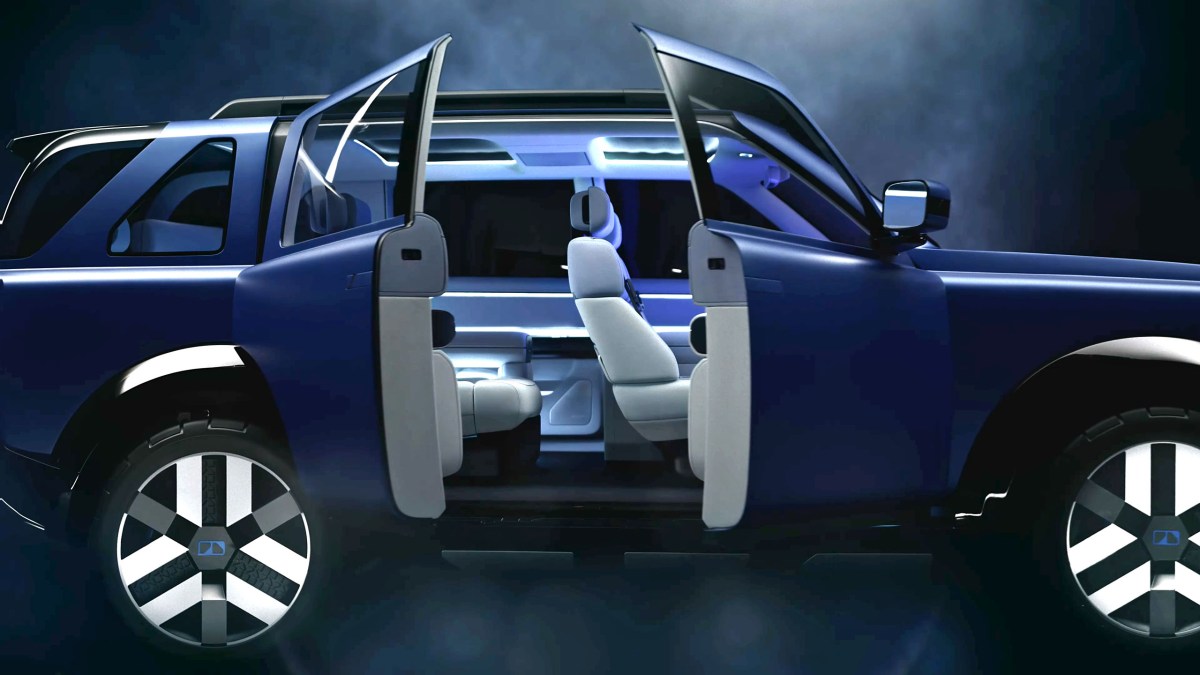
The diagonal D-pillar treatment is an obvious nod to the namesake’s heritage. It’s a big part of the Freelander’s identity, and is assured for production, considering how the Concept 97 leans on that motif for all its branding down to the tiniest physical details. The “FL” logo—rendered as two triangles, just like the rear-quarter glass—appears throughout the SUV, from its lighting to roof and interior trim, even stretching down to the pedals. Very clever stuff.
China Auto Show via YouTube
You do wonder about those rear-hinged doors, though. I’m a big fan, of course—I’d love for plenty more automakers to bring them to market—but this implementation could merely be a party trick for auto shows. At least one crash test, reported by CarExpert in Australia, would seem to support that prediction. Hopefully, there will be other models that offer the privilege of easier entry.
Inside, Concept 97 has more, shall we say, progressive seating arrangements that aren’t going to fly for the road car. Overall, there’s less personality in here than out there, with a gigantic central infotainment screen and little else of note on the dashboard. The steering wheel almost looks like a Hyundai part.
We’re supposedly due to see a version of the Concept 97 that people will actually be able to buy in June. This seems to be a real test for JLR to globalize a spun-off brand with Chinese roots, as the new Freelander will be built at the Changshu plant, replacing production lines for the Discovery Sport and Evoque.
Got a tip? Reach out to tips@thedrive.com
Backed by a decade of covering cars and consumer tech, Adam Ismail is a Senior Editor at The Drive, focused on curating and producing the site’s slate of daily stories.
