

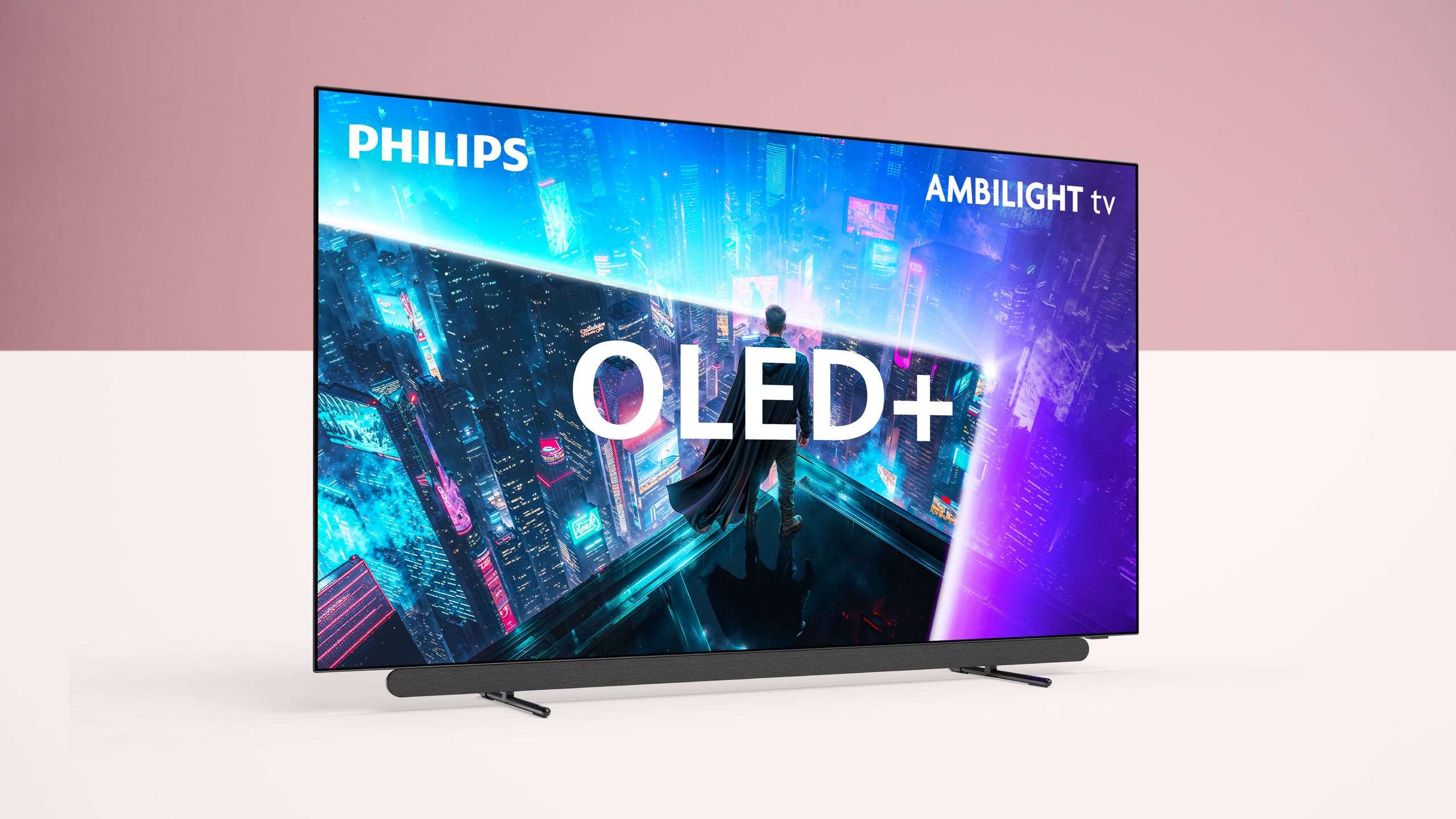
Philips has revealed its 2026 OLED TV lineup and it includes the world’s first OLED models to support Dolby Vision 2. The lineup consists of four models: the flagship OLED+951, the nearly-flagship OLED+911, the mid-range OLED811, and the entry-level OLED761.
The top three of these models will support Dolby Vision 2 Max (the OLED761 misses out), which has all the features of Dolby Vision 2 — better tone mapping, Precision Black for dark tone accuracy, and Light Sense for adjustable image quality — plus the Max-exclusive Authentic Motion, where filmmakers can tell a TV how to apply its motion settings to reduce judder, rather than letting the TVs go wild on their own.
Philips TV had previous announced the names of these TVs and the promise of DV2 support at CES 2026, but this is the first time we’ve learned… well, anything else about them.
Article continues below
You may like
For a full rundown of each TV’s features, specs and release dates, check out below. There’s no pricing information available yet, but we’ll be watching for it closely, because the Philips OLED910 was one of my favorite TVs of last year because it was basically a flagship OLED for closer to mid-range prices, and I really hope we see the same this year.
Philips OLED+951
- Release date: September 2026
- Sizes available: 65 and 77 inches
The Philips OLED+951 will come with the new META 4.0, Primary Tandem RGB 2.0 OLED panel, said to be capable of 4,500 nits peak brightness and 400 nits fullscreen brightness, which would make it one of the brightest OLED TVs on the market — I don’t expect it to hit the 4,500 nits peak brightness figure in any kind of mode I’d actually want to watch, though.
What to read next
It will support Dolby Vision 2 Max, featuring Authentic Motion which enables judder reduction and motion adjustment to be controlled by content creators on a moment-to-moment basis, rather than having a universal setting on the TV.
It has a dual-chip P5 10th Gen picture processor, making it Philips’ most advanced screen when it comes to image refinements. Unique features include Specular Highlight Enhancement, AI Machine Learn Sharpness V3, AI Smart Bit Enhancement V4, and AI Perfect Reality V4. It’s capable of individual frame analysis of incoming HDR signals, to more precisely match the original light output on the OLED screen.
There are four HDMI 2.1 ports, with 4K at 165Hz support on all of them, plus variable refresh rate and other gaming features.
There’s a 2.2-channel sound system with 70W of power, but Philips really expect you to match this TV with an external sound system — all the effort has been put into the image processing here. It has a four-sided Ambilight, and supports AmbiScape.
Philips OLED+911
- Release date: June 2026
- Sizes available: 48 (new), 55, 65 and 77 inches
The Philips OLED+911 will have the same next-gen Primary Tandem RGB 2.0 panel as the OLED+951, but will have a single-chip P5 10th Gen image processor, meaning that it has image processing that’s generally at the level of other flagship TVs, just without the the little extra touches Philips’ puts on its priciest model.
The OLED+911 will also feature a Bowers & Wilkins 3.1 sound system, similar to that featured in the OLED910, although Philips says this has been further refined. It has also undergone a design change, taking on a more compact approach but it is still attached to the bottom of the TV facing forward, for direct sound.
Basically, this is a complete high-end AV package, whereas the OLED+951 is more of a super-elite screen that’s intended to be used with a sound system.
For gaming features, the OLED+911 will support 4K 165Hz and has four full-featured HDMI 2.1 ports. It will also have a four-sided Ambilight setup and AmbiScape.
Philips OLED811
- Release date: June (55 inches), August (42, 48, 65 inches), September (77 inches) 2026
- Sizes available: 42, 48, 55, 65 and 77 inches
This mid-range OLED has a “new higher output OLED_EX panel” according to Philips, which it claims is capable of 2,500 nits of peak brightness — generally, Philips lists the same ‘capable’ figures as LG Display (which makes the panels), which is always different to what we measure in real-world use in image modes that actually look good.
But any improvement over the 1,180 nits peak brightness and particularly the 195 nits fullscreen brightness that we measured in the LG C5 (which uses the previous gen panel that this new Philips’ TV should offer an improvement over) will be welcome.
This set also supports Dolby Vision 2 Max, and uses the same P5 10th Gen processor as the OLED+910, and also supports 4K 165Hz on all four HDMI 2.1 ports.
It has a three-sided Ambilight, and supports AmbiScape. There’s a 70W 2.2-channel sound system at most sizes (50W in the 42-inch model).
Philips OLED761
- Release date: June 2026
- Sizes available: 55, 65 and 77 inches
The cheapest model uses the new OLED SE panel from LG Display, which promises up to 1,000 nits of peak brightness, but again we don’t expect it to necessarily hit that in real use.
Again, though, any improvement over the 665 nits of peak brightness and 131 nits of fullscreen brightness that we measured in the OLED760, its predecessor, will be welcome.
It has a P5 7th Gen image processor, so will be a little behind the other TVs here when it comes to detail, motion handling and upscaling of lower-quality footage, but we’ve always found Philips’ cheaper OLEDs to still do all this stuff well.
Philips hasn’t mentioned any support for Dolby Vision 2 here, but it has 4K 120Hz support across all four HDMI ports, so will make for a great-value gaming set. It has three-sided Ambilight and AmbiScape support.
Philips doesn’t specify the sound system on the smaller models, but it’s a 2.2-channel setup on the 77-inch.
The OLED+911 is the one to watch
The Philips OLED910 (pictured) was one of the best value TVs of last year, so I’m hoping the OLED+911 can follow in its footsteps. (Image credit: Future)
I recently got to test and review the Philips OLED910 and I gave it the full five stars. Not only did it deliver staggering picture quality with gorgeous colors and powerful contrast, but it offered detailed and powerful built-in sound that means you don’t need to invest in a soundbar. It was also a powerhouse for gaming and featured my favorite thing about any TV: Ambilight.
The beauty is it did all this as a flagship OLED at a more mid-range price. Roughly £200 cheaper than major rivals and some of the best OLED TVs available — including the LG G5, Samsung S95F and Panasonic Z95B — the OLED910 was closer priced to the mid-range LG C5 and Samsung S90F, but had the flagship performance to sit above these TVs. In my opinion, it was one of the best-value TVs on the market last year, so the OLED+911 has got some big shoes to fill.
Thankfully, on paper, the OLED+911 should meet and even exceed my expectations. I’ve seen the Primary Tandem RGB 2.0 panel in action on the LG G6 and it looks more refined which can only be a good thing with Philips’ picture quality. It also supports Dolby Vision 2 Max, which we’ve seen in action and looks great.
I’m also delighted to see that the awesome Bowers & Wilkins sound system featured in the OLED910 is still present in the OLED+911. It was easily one of the most impressive built-in speaker systems I’ve heard from a TV last year.
The addition of four HDMI 2.1 ports is welcome news for a gamer like me as really the lack of four HDMI 2.1 was the only setback for the OLED910’s gaming setup. But, I’m really excited about the prospect of AmbiScape. I’m a real lover of Ambilight as I feel it adds a unique touch to viewing experience and now that that can be extended onto other light bulbs in the room? I can’t wait.
If Philips can once again deliver a TV the calibre of the OLED910, with these new features and undercut its rivals again, it could be a real contender in 2026. I can’t wait to get my hands on it.
The best TVs for all budgets
Our top picks, based on real-world testing and comparisons
Follow TechRadar on Google News and add us as a preferred source to get our expert news, reviews, and opinion in your feeds. Make sure to click the Follow button!
And of course, you can also follow TechRadar on YouTube and TikTok for news, reviews, unboxings in video form, and get regular updates from us on WhatsApp too.
