

The biggest car news and reviews, no BS
Our free daily newsletter sends the stories that really matter directly to you, every weekday.
Getting the 2027 Chevrolet Bolt EV to showrooms after it was killed and resurrected required a lot of creativity. General Motors’ flip-flop on the affordable EV meant moving an assembly line and hoarding parts to build prototypes in order to restart production as quickly as possible. But as the Bolt’s chief engineer Jeremy Short explained to The Drive, there was another surprising key to meeting the tight deadline: virtual crash testing.
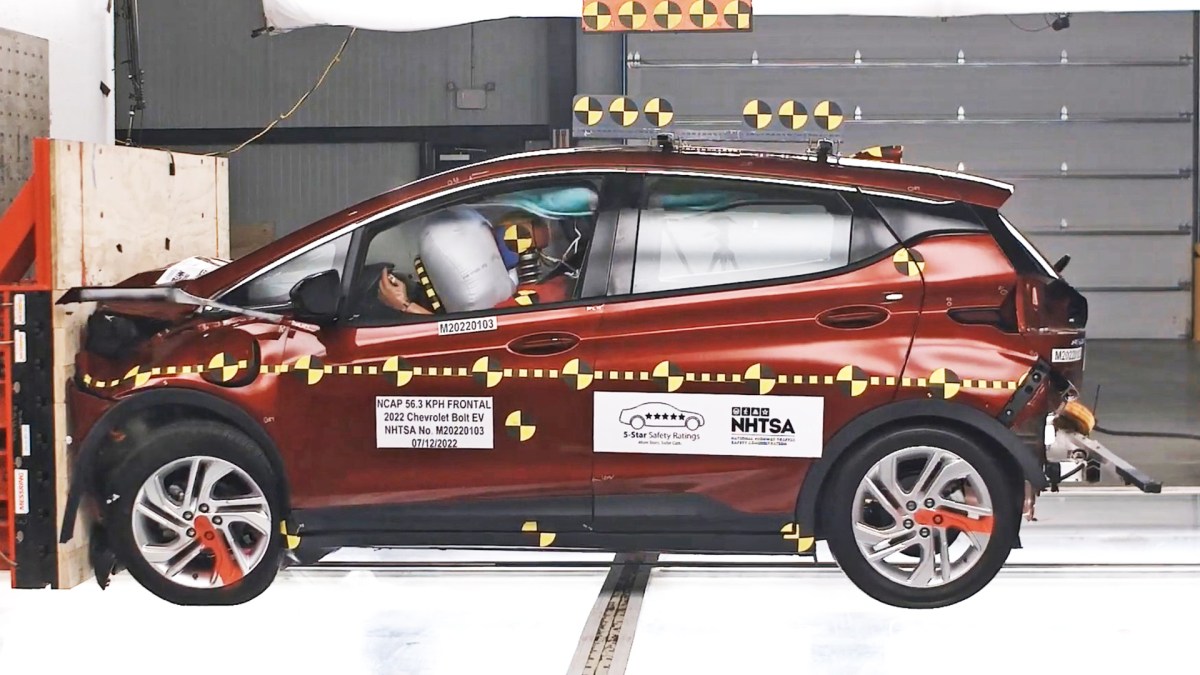
Virtual crash testing is exactly what it sounds like. Instead of bending metal, engineers run simulations with complete 3D models of a car. These are based on commercially-available software with some of GM’s own add-ons, correlated to real-world testing of specific components like airbags and seats. These software tools have been in use for a while, but for the 2027 Bolt EV, engineers were so confident in them that they mostly dispensed with crashing pre-production cars, only conducting the final test necessary for regulatory homologation in the real world. As Short put it, “we’ve greatly reduced the number of cars we run into walls.”
“It is astonishingly good,” Short said. “It’s a fairly complex 3D model of the vehicle that has every component on the vehicle, and then it has to have mechanical properties of the plastics, the steel and everything.” Engineers can replicate crash tests, as well as repeat for variations, such as moving a weld or changing the size of a single bracket, or different speeds, without having to crash a real car.
The 3D models are animated, and they do show a crumpled car at the end of a test, but they’re not photorealistic, Short clarified. GM declined to provide screenshots or videos from their actual tests on the Bolt, but this old YouTube video gives you a rough idea of how it looks. Note how visually accurate the simulation is compared to the real thing, and keep in mind that this video is over 15 years old. Safe to say the technology has gotten even better since then.
Virtual crash test of Taurus using ATI FirePro V8800 and HyperWorks
Regardless, the visuals are less important than the numbers being generated. These numbers, corresponding to the amount of force acting on specific parts of the car or a crash-test dummy, are how the tests are scored. The appearance of a crash—virtual or otherwise—can also be misleading.
“It’s sometimes like the worst-looking crash is better and sometimes the one that looks like a nothingburger is actually the one where we have to make changes,” Short said.
The resurrected Bolt EV shares a lot with the version that was discontinued after the 2023 model year, but enough changes were made that a full suite of crash tests were still needed. New regulations were put in place after the Bolt EV was last crash-tested, and changes to the interior needed to be tested to ensure they didn’t interfere with airbag deployment. Engineers made “drastic” changes to the front structure, but testing them virtually saved time and money, Short said.
Virtual crash testing avoided having to destroy about two dozen expensive pre-production cars, and just getting those cars would have been difficult because as development work was being done, GM was in the process of moving the Bolt EV assembly line from Michigan to Kansas. So bodies to build prototypes were hard to get. But the amount of flexibility afforded by virtual crash testing made it worthwhile on its own, Short said.
“If you gave me a conventional program, I would absolutely go a virtual route because it’s simply better.”
Got a tip? Send us a note: tips@thedrive.com
Stephen has always been passionate about cars, and managed to turn that passion into a career as a freelance automotive journalist. When he’s not handling weekend coverage for The Drive, you can find him looking for a new book to read.
