

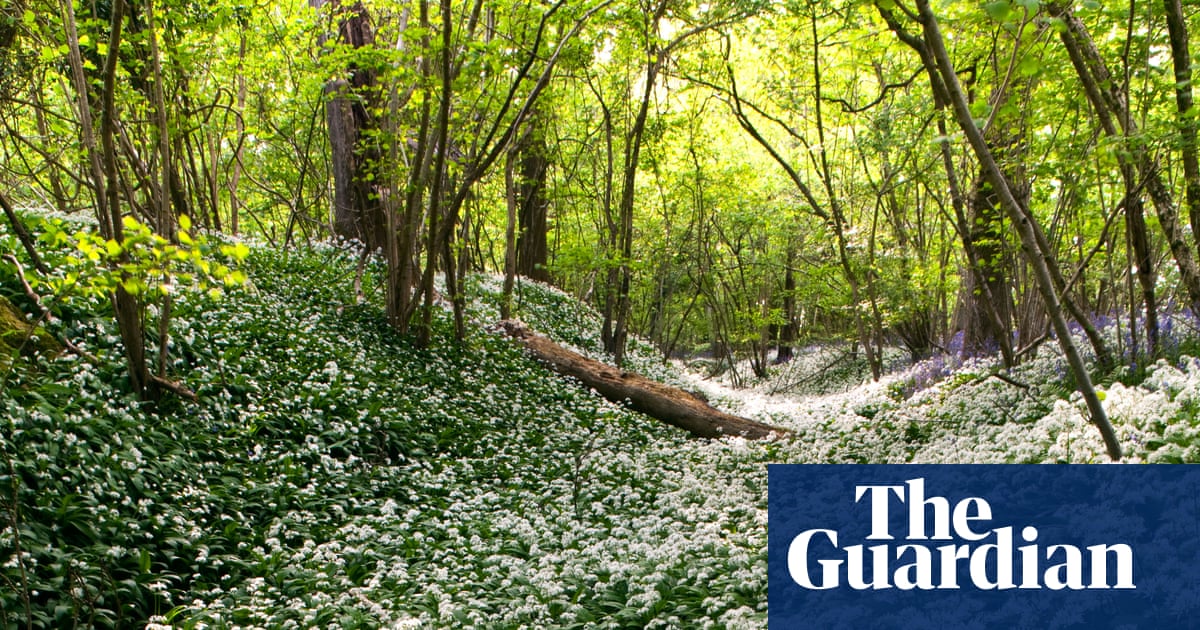
Unlike most gardeners, I’m not especially captivated by spring bulbs. I do love that they symbolise the return of fairer weather, but I only have the tulips and narcissi that I adopted when we moved here and, every autumn, I fail to consider planting more to replenish their dwindling numbers. Lucky for me, I also adopted the kind of spring bulb that I’m more inclined towards – because they’re edible. Wild alliums are what I’m really looking for to herald the arrival of spring.
The Guardian’s journalism is independent. We will earn a commission if you buy something through an affiliate link. Learn more.
Too many edible wild plants are only edible in theory, in my opinion. I’m mostly of the “just because you can, doesn’t mean you should” school of foraging. But that’s not the case when it comes to the most well-known member of this wild allium group. The strongly flavoured leaves of wild garlic (Allium ursinum) cover the woodland floor wherever they are resident, producing clusters of white, star-shaped flowers that are edible too – but leave most of them for the pollinators please! I’m a big fan of this delectable plant and am fortunate enough that it has made a home in my front garden. As with all foraging endeavours, make sure you’re 100% certain you have identified the plant correctly, pick where you are allowed, and always leave plenty behind. Fortunately, when it comes to this group of plants, it’s fairly easy to know if you have gone wrong as all the leaves should smell strongly of and taste like garlic or onions.
double quotation markIt is possible to introduce wild garlic into your garden but I would exercise caution as it will romp away
Another wild allium that I found growing out of the gravel in my garden is crow garlic (Allium vineale). A much less showy allium, it looks like a skinny chive and can be easily missed if it’s growing in long grass, but it’s a darker, duskier green and has an unmistakable onion-y smell when you pick a leaf and crush it. Unlike wild garlic, which I like to use in place of spinach or similar, crow garlic is more of a garnish, but still worth eating.
Three-cornered leek (Allium triquetrum), though less common than wild garlic, spreads thuggishly. It produces long, narrow leaves with a ridge down the middle and bell-shaped white flowers which can be used in any dish that calls for greens. I find it less palatable than wild garlic, but what it lacks in deliciousness it makes up for in abundance. That is probably why it’s actually illegal to plant it in the wild.
It is possible to introduce wild garlic into your garden – via bought bulbs or donated plants from a friend’s patch, as opposed to digging some up in the wild – but I would exercise caution as it will romp away season after season and can become difficult to contain. Nonetheless, I haven’t sought to curtail its spread yet because I’m overjoyed to see my wild garlic reappear every spring.
