

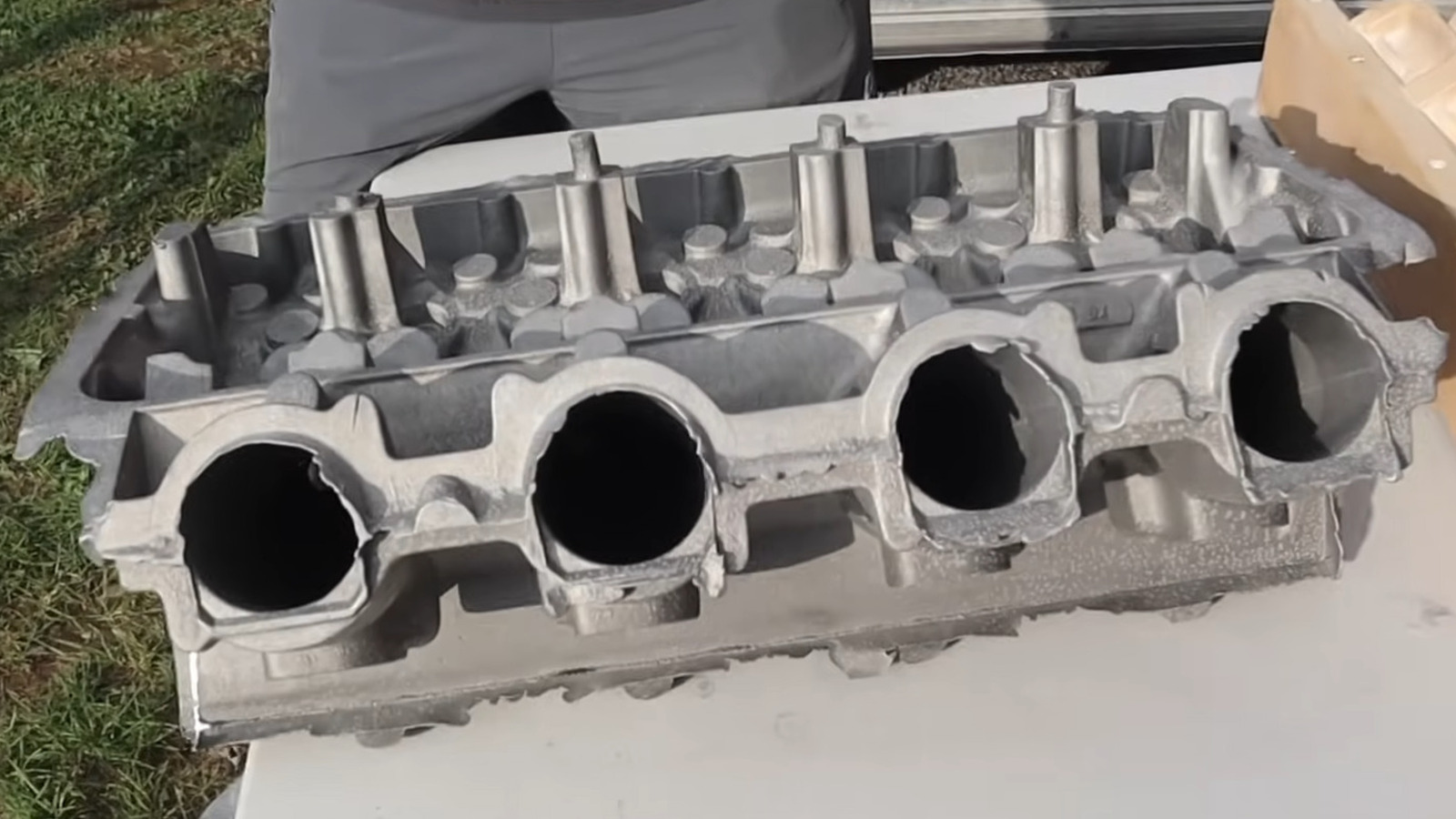
Even some die-hard Ford fans may be unfamiliar with the Calliope (that’s kuh-lie-uh-pee) race engine, an incredibly rare V8 that was built exclusively for Le Mans.
The exact timeline is a bit murky, but as Dan Schoneck of Schoneck Composites explained in a video featured on REVan Evan’s YouTube channel, it was around the time of the mid-’60s Le Mans Ford-versus-Ferrari era that Blue Oval started working on the Calliope. Mind you, this was just before the Commission Sportive Internationale (CSI) decided to virtually axe any hope for Ford’s big-block engines participating in Group 6 racing. According to Schoneck, the race V8 would have probably ended up in the Mk IV GT40 (not the million-dollar track-only GT Mk IV, obviously), with Ford likely aiming for gold in the ’68 season.
Much of the engine’s details are still shrouded in mystery, as only three prototypes were built, with only one in Ford’s custody — at the Henry Ford Museum. The whereabouts of the other two remain unclear. That said, Schoneck managed to visit the facility, photograph the engine, and collect as much information as he was permitted to. Technical details include a 4.34-inch bore and 3.60-inch stroke, meaning it’s a fairly over-square engine. Ergo, plenty of revs. And it was fairly rev-happy, with the Calliope managing to push 630 horsepower at 6,300 RPM. Per Hot Rod, Ford was eyeing 800 horsepower with a redline set to 8,000 revs. Although testing was mostly limited to dynos, one of the prototypes eventually ended up in a Can-Am test car.
Ford’s Calliope V8 always had racing intentions
But that was the last anyone heard of this experimental race V8, which reminds us of the Ford 427 “Cammer” and the 426 Hemi – the former was banned from NASCAR. So what’s with the “Calliope” name, you ask? A Calliope is a uniquely American instrument –more specifically, a steam organ that’s capable of producing high-pitched sounds from its many long and short tubes. Observe the V8, and you’ll notice the velocity stacks share a resemblance with the instrument’s whistles, plus it’s entirely American.
Schoneck, who has now cast the cylinder head, revealed some of the engine’s intricacies. Although the 427 Calliope was a clean-sheet design, he noticed the oil filter adapter looked very FE-like. But that’s about it. The engine follows a semi-hemi or pent-roof combustion chamber layout with a pushrod three-valves-per-cylinder design, featuring two intake valves measuring 1.66 inches and a single exhaust valve that’s 1.809 inches in diameter. The intake manifold is a part of the head casting, as are runners and the individual throttle bodies, according to Schoneck.
A unique design quirk that will grab your attention is how the exhaust camshaft is located about 4.5 inches higher than the intake camshaft. Also, the exhaust ports are oval, which should open doors for some interesting high-performance header styles. All told, it’s still very much a work in progress.
