

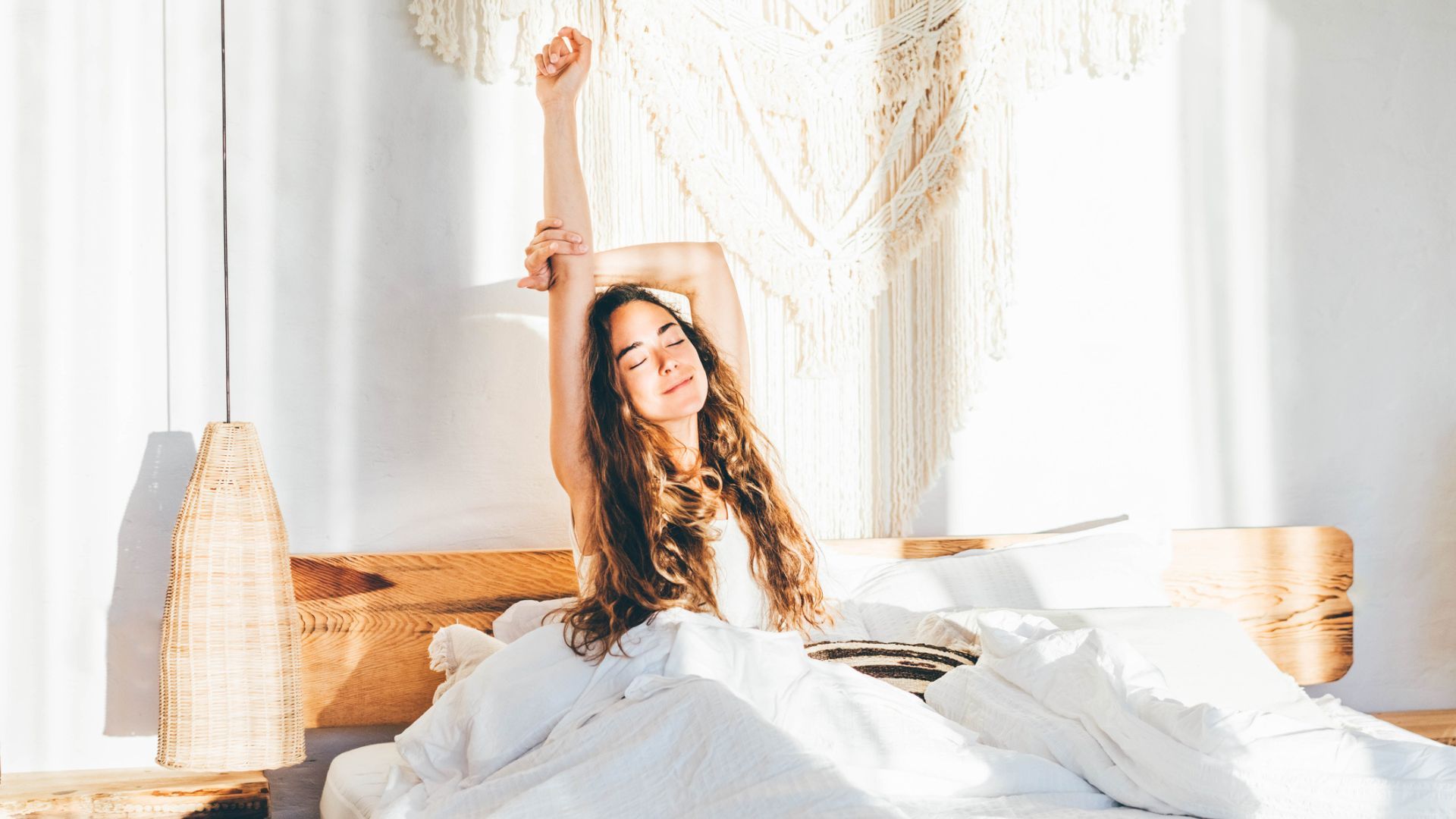
After months of dragging myself out of bed exhausted, I had no choice but to tackle my morning grogginess head on. So when I heard about the Dutch sleep method and how sleeping with your blinds open could help boost energy morning levels, I jumped at it.
While the Dutch sleep method didn’t work for me (I explain why below ), I did discover five easy sleep hacks that do help me banish fatigue and feel more like a spring lamb than a zombie in the mornings.
In a few short weeks I’ve tripled my energy levels and I’m waking up naturally. Here are the hacks that are finally making a difference…
The 5 sleep hacks helping me to sleep better and wake with more energy
1. I’m blocking out all ambient light
Light pollution is a stealthy stealer of sleep, with studies showing that it can make it harder to both fall and stay asleep. As a result, I have two blinds up in my bedroom to block out any light from outside.
I’ve also removed anything that gives off a glow inside my bedroom. That includes chargers and the ‘stand-by’ glare of some electronics.
Optimizing my bedroom in this way helps me sleep better. Not only am I blocking out the sleep-stealing ambient light, but having something in the window helps instill a sense of security that was missing during the Dutch sleep method. My room is now pitch black and I feel safe — it’s bliss.
2. I’m waking up to sunshine exactly when I want to
Introducing a sunrise alarm clock to my morning routine has had the biggest impact on my sleep and energy levels out of all the hacks and methods I’ve tried.
Unlike the Dutch sleep method, which is dependent on clear skies and the changing sunrise, I can set the ‘sun’ to come up at any time of my choosing.
(Image credit: Future)
Now, I’m waking to the glow of sunshine and the sound of mechanical tweeting birds at precisely 6 a.m, regardless of the sun’s actual schedule.
Waking up to a gradual sunrise (albeit simulated) means that I’m being drawn out of deep sleep before I even open my eyes. This helps me avoid sleep inertia — if you’ve ever woken up after eight hours of sleep and still felt groggy, the chances are it’s because your alarm rudely awakened you during deep sleep.
Sunrise also helps promote the production of the get-up-and-go hormones cortisol and serotonin, which helps you feel alert and improves your mood.
3. I’m sticking to a regular sleep schedule
A groundbreaking study by Vitality and The London School of Economics and Political Science (LSE) suggests that going to bed within the same one hour window while clocking up seven hours sleep a night, at least five times per week, could add four years to your life. This has been dubbed the 7:1 sleep rule.
Another benefit of a regular sleep schedule is that it anchors your circadian rhythm, which is your body’s internal clock.
Since I’ve made a regular routine a priority, I’ve found that my body thrives on it; I’m falling asleep faster and I’m waking up shortly after my sunrise alarm clock starts to glow (before the mechanical birds even begin to chirp).
So, while the Dutch sleep method didn’t work for me, I’ve found other ways to achieve the same morning energy boost — and I don’t have to worry about nosy neighbors peeking through the windows.
4. I’m taking daily nature walks
I’ve been factoring in a 30 minute forest walk into my daily routine for a few weeks now, and the benefit on my sleep (and stress levels) has been profound. On the days that I spend time immersed in nature I find that I fall asleep faster and I sleep deeper.
The science backs it up, too. A 2019 study suggests that spending between twenty and thirty minutes outside among nature three times per week can significantly lower cortisol levels, regardless of the time of day.
(Image credit: Shutterstock)
However, if you’re able, walking in the morning comes with a whole raft of added sleep benefits. “Natural morning light signals to our brain that it’s morning, i.e. time to get active, by suppressing any melatonin that’s still lingering,” Dr. Catherine Darley, a Naturopathic Sleep Expert and founder of Skilled Sleeper, previously explained to me.
By suppressing melatonin levels, natural sunlight exposure in the morning helps stave off sleep inertia and increase energy levels.
5. I’m addressing my 3 a.m. triggers
Although it’s ramped up within the past 12 months, waking up at 3 a.m. and being unable to fall back asleep is something I’ve been battling on and off for years. As a result, I’m rarely as rested as I should be when my alarm goes off.
Tackling these 3 a.m. triggers is an ongoing process — is it hormones? The time I’m eating dinner? My nighttime anxiety? Or, more than likely, all of the above?
(Image credit: Getty Images)
However, I’m learning how to lean into what helps keep my 3 a.m. wake ups at bay. For me, that’s keeping my bedroom a cool, calm and clutter-free space that’s optimized for sleep.
Crucially, I’m also working on ways to lower my cortisol levels during the day, the ‘stress’ hormone. Cortisol levels peak when you wake up so that you feel alert and ready for the day, but levels start to rise in the early hours of the morning. That’s called your Cortisol Awakening Response (CAR).
When your baseline levels of cortisol is higher than normal, that rise can be enough to wake up — and it’s typically around 3 a.m. Journaling, time outdoors (see above) and plenty of exercise helps keep my cortisol levels regulated and nighttime awakening limited.
Top tech for better sleep and increased energy
Why the Dutch sleep method didn’t work for me
Initially, I tried the Dutch sleep method by accident; I moved house and it was a few days before I installed a blind in my bedroom. But when I read about the benefits of this sleep ‘hack’, I decided to take note of how it impacted my rest.
I hoped I’d wake up bathed in light and with bags of energy, but instead I slept terribly every night of testing the Dutch sleep method.
(Image credit: Getty Images)
For starters, I don’t know if there are fewer street lights in the Netherlands, but I can tell you that there’s one right outside my bedroom window here in the UK. It’s a cold blue light that casts long shadows and makes glancing around my room look like the opening sequence of my very own horror film.
I could have blocked out this spooky ambient light with an eye mask, but then I would have blocked the sunrise too. (Also, there’s something unsettling about wearing an eye mask when your bedroom curtains are open.)
Second, most mornings my alarm goes off before the sun comes up anyway. So I’m not even in bed to catch those first sun rays, defeating the whole point of the method.
Today’s top sunrise alarm clock deals
