

The biggest car news and reviews, no BS
Our free daily newsletter sends the stories that really matter directly to you, every weekday.
Just the other day, Chevy announced the return of the Corvette Grand Sport, and with that, it also teased the introduction of a next-generation V8. Say goodbye to the 495-horsepower, 6.2-liter LT2, and hello to the 535-horsepower, 6.7-liter (409 cubic inches—giddyup!) LS6. Yep, it’s back. Well, sort of.
We’d say this isn’t your grandpa’s LS6, but this nomenclature was already revived once before, and the last one wasn’t retired all that long ago. It was first used in the ’70s, but the name was more recently used for the 5.7-liter V8 that was phased out of the Corvette’s engine portfolio fairly early in the C6’s lifecycle. It was replaced by the 6.2-liter LS3 in 2008.
Apart from the name, the new LS6 has virtually nothing in common with its predecessors, apart from its general mission and dimensions. It’s more accurate to call it an evolution of the LT2 it is directly replacing—and it is replacing it. The 535-horsepower LS6 will be fitted to the 2027 Corvette Stingray, Grand Sport, and Grand Sport X. Yep, everybody gets to play (except for the Z06 and ZR1 models, of course). Oh, and the E-Ray? It’s dead—or more accurately, superseded by the aforementioned Grand Sport X. Sorry, haters. Those electrified Corvettes aren’t going anywhere soon.
As an evolution of the LT2, the LS6 inherits most of that engine’s basic characteristics. It still has the same 4.4-inch bore diameter (a GM small-block signature) and fits in the same space (hence the default inclusion in the Stingray). Chevy’s performance engineers went over every inch of the engine looking for opportunities to improve performance.
Byron Hurd
Since the bore size is the same, it should come as no surprise that Chevy found an extra half a liter of displacement by increasing the piston stroke by 8 mm. This extra travel means increased piston speeds, which translates to more heat. A new two-piece water jacket augments the cooling around the combustion chamber hot spots (near the exhaust valve and spark plug, mostly).
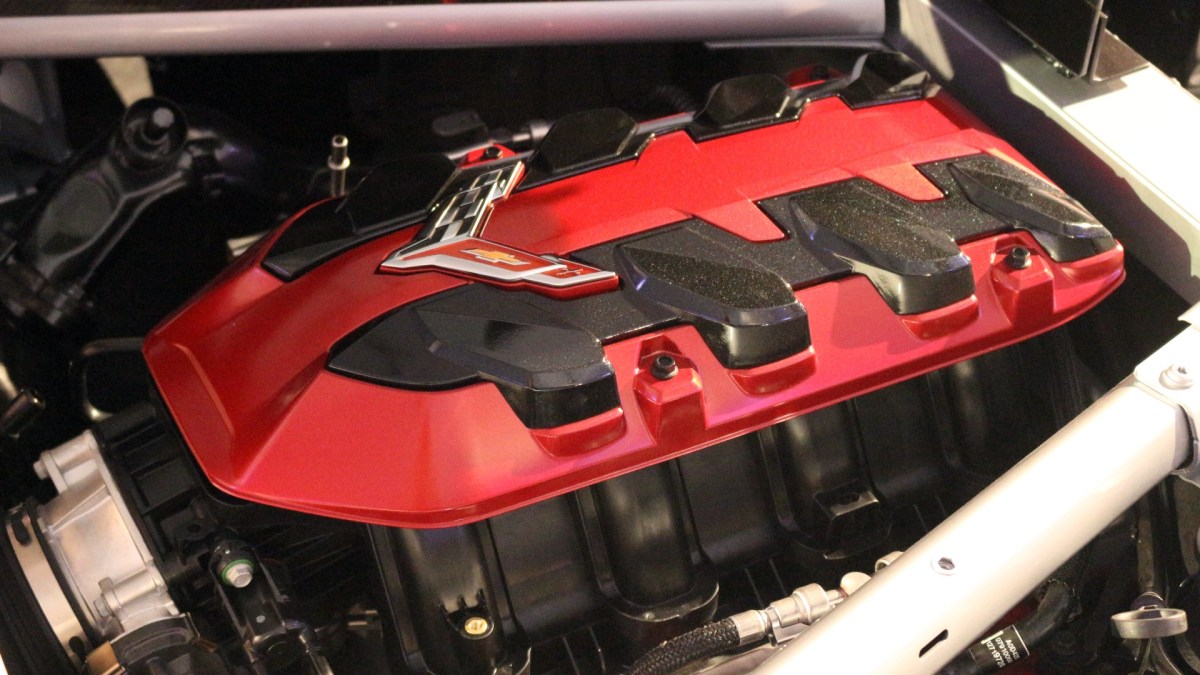
A redesigned intake plenum allows the engine to ingest more air, so they made the throttle body a little bigger, too. A new ECU also gave Chevy’s engineers more control over fueling and timing, allowing them to bump the compression ratio up to 13:1—a figure that once required leaded gas to achieve. Welcome to the future.
As a result, the LS6 not only offers more power and torque than the LT2, but it does so across the entire rev range (up to its 6,600-RPM red line). The torque figure itself? 520 pound-feet—the most of any naturally aspirated production V8. Go ahead and Google the Godzilla; you’ll be disappointed.
LS6 lead engineer Mike Kociba likened the combined effect of these upgrades to fitting a small supercharger to the LT2, and all without the added complexity that comes with forced induction.
For now, the LS6 will appear only in the Corvette, the engines for which will be built in Flint, Michigan—not GM’s Tonawanda facility, where the current LT2 is assembled alongside the company’s small-block L84 and L87 truck engines. But based on what we’re hearing, it’s only a matter of time before the LS6’s updates trickle down to the rest of the engine family, at which point Tonawanda will probably be back in play. Stay tuned.
Got a news tip? Let us know at tips@thedrive.com.
Byron is an editor at The Drive with a keen eye for infrastructure, sales and regulatory stories.
