

As I’m sitting in my office writing this review, delicious, cheesy, garlicky scents are wafting up the stairs. I can hear whizzing and whirring, and the occasional clunk, as a robot chef in my kitchen is making macaroni and cheese. Its app tells me there are three minutes left in the process, and based on the snapshot it’s showing, the dish looks like a creamy pile of cheesy goodness.
I’ll be heading out the door shortly to pick up my daughter from the school bus, and when we’re back, the robot-cooked mac and cheese will be waiting for her to dive into, staying fresh thanks to a “copilot” mode that keeps it warm and stirs it occasionally until we’re ready.
$1500
The Good
- Fully autonomous cooking
- Makes really good food
- Actually saves time
- Over 1,000 recipes and counting
- It’s a robot chef!
The Bad
- Expensive, plus a subscription
- Still have to prep
- Software can be buggy
- Takes up a lot of counter space
- Requires an internet connection
Meet Posha, my latest foray into the fascinating world of smart kitchen gadgets. Posha is a $1,500 countertop cooking appliance with a $15 monthly subscription that uses AI computer vision, a robotic stirring arm, and automated food and spice dispensers to autonomously cook a meal from start to finish.
It’s an absurd luxury, too dependent on the internet, and feels like a first-gen device in many ways. But it’s also a really good cook, saved me hours of standing over a hot stove, and is a glimpse into the future of home robots in the kitchen.
It took me less than five minutes to load the mac and cheese ingredients into Posha, and the robot handled the rest: sauteing some garlic, pouring in the milk, flinging in the pasta, filling it up with water to cook the pasta, then adding the cheese and stirring it all into a thick, gooey mass.
The result was that, even during my 10-hour workday, I could still offer my daughter a tasty home-cooked meal at 4:30PM, when she got back from school. The alternative in a similar time frame would be a hastily microwaved box of processed mac and cheese. The Posha meal tasted much better.
This is the whole idea behind Posha: to help working families put freshly cooked meals on the table every day without spending a lot of time doing it. As any working parent will tell you, eating well and having enough time to eat well can be a real challenge.
Posha founder Raghav Gupta grew up in India, where he says he saw love expressed through food and witnessed friends and family struggle to choose between careers and providing home-cooked meals to their families. That struggle is global, and entire appliance categories and businesses have been developed to solve it.
To children of the 1980s, the microwave meal was one solution. For today’s kids, the meal kit delivery service may loom large in their memories of home-cooked meals. In the ’80s, microwaves were expensive; meal kits can cost thousands of dollars a year. With that context, a $1,500 robot chef doesn’t seem quite so absurd.
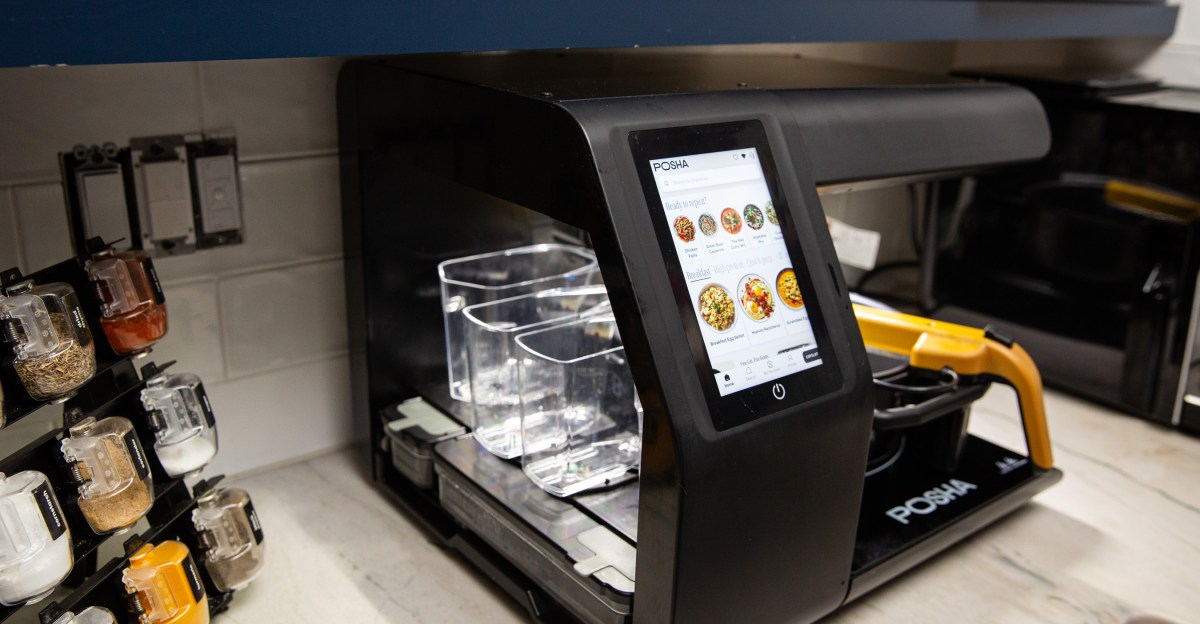
Prepped ingredients go in one of four containers (sometimes doubling up.)
Spices and seasonings go in special pods that fit in a motorized tray above the cooktop.
The device is controlled by a touchscreen. Select your recipe, customize, and then view the steps it’s taking in real time.
During the cooking session, the device handles adding all ingredients at the right moment, as well as seasonings, water, and oil.
Posha is designed to mimic the way a human chef cooks. It can cook almost anything that fits in a single pot, and the company has devised methods for making dishes you might not associate with one-pot cooking — such as chicken wings and roasted veggies — within the constraints of its form factor.
It’s a similar concept to other modern cooking robots, the Thermomix and the Instant Pot. The main difference is that Posha is totally autonomous once you’ve added the ingredients, whereas many dishes in the Thermomix and Instant Pot require ongoing intervention.
About the size of a large countertop microwave, the Posha is at heart a 1,800-watt induction cooktop with a robotic arm and a camera. It autonomously stirs, heats, and times each step of cooking the dish in a proprietary pan while the camera watches the food and analyzes its color, texture, and consistency, adapting the cooking as you might if you sense the sauce is too dry or the onions are not translucent enough.
1/5I made dozens of dishes in the Posha and everything was super tasty. This is chili con carne.
You have to prep the ingredients, including chopping, weighing, and placing them into one of the four plastic containers, which slot into designated holders from where they will be flung into the pot at the appropriate time. A motorized spice tray rotates special pods to release the right amount of seasoning at the right time, and oil and water dispensers do the same for those liquids. The robotic arm features three swappable spatulas intended for different tasks.
It took complicated and time-consuming dishes and turned out restaurant-quality cuisine with minimal effort on my part
You choose a recipe from the embedded touchscreen, which also includes all the device’s controls, load the ingredients (all at once or prep as you go), and come back 30 minutes to an hour later to a fully cooked dish.
Watching it work is fairly mesmerizing; it’s methodical, and the process is similar to how a human cooks. It generally starts with the seasonings, then adds the protein, followed by the other ingredients and a sauce if required. Its skills at sauteing chicken were impressive.
Each dish can be tailored for one to four people and customized.
The spatulas connect to the robotic arm.
The containers fling the food into the pan and bang it repeatedly to get all the ingredients out.
The motorized spice tray holds 6 pods.
A dish does tend to take a bit longer than I would if I were making it myself; my guess is because it’s constantly analyzing the food and adapting as it goes. But as I don’t have to stand there and watch it (you can keep an eye on it through a companion mobile app if you want), that didn’t bother me.
The company sold out of its first batch of production units, which it started shipping in January 2025. It’s currently working through a preorder waitlist that costs $25 to join. The full retail price is $1,750, but preorders get it for $1,500.
I know what you’re thinking. The prepping and the cleanup are often the worst bits. The actual cooking is the fun part. I agree, and was deeply skeptical about the device when I first saw it demoed at the Smart Kitchen Summit in 2024. But after three months of using it, I’m a convert.
I cook most evenings, and even though I enjoy it, seven nights a week wears thin. I regularly revert to takeout or a Trader Joe’s freezer meal special when I’m just too tired. But since we’ve had the Posha, my takeout bill has dropped, and my time spent with my husband and hanging with my kids has increased.
With Posha, I can prepare a meal in five to 20 minutes, and spend the hour or so I would have spent cooking doing something else. It’s been a huge time-saver. While a slow cooker or Instant Pot operates similarly, Posha’s stovetop method produces more varied results. My husband is also a fan, lauding every dish we’ve tried as “excellent and flavorful.” When I went away on a business trip for a week this fall, he whipped up a few meals himself and was impressed by how easy it was to use.
It’s an absurd luxury. But it’s also a really good cook and a glimpse into the future of home kitchen robots.
Posha has also helped me avoid cooking disasters, like burning the garlic while multitasking, and expanded my weeknight repertoire. Like most families, we get in a rut, and I generally make the same few dishes every week. Doing something new requires a fair amount of effort, but Posha has made it easier. Browsing its recipe library in its companion app and adding a few new ingredients to my shopping list is simple, and consequently, we’ve tried a lot of new dishes, in particular curries.
One key to Posha’s success is that it is infinitely more patient than I am. I’ve tried making curry before, but it rarely turned out great. Posha knows how to layer flavors properly, adding the right amount of spices at the right time, cooking the proteins perfectly, and the sauces with precision — skills that can take years to learn.
Almost every dish I’ve cooked in it has been delicious and full of flavor. From butter chicken and paneer curry to chicken risotto and shakshuka, it took what can be complicated and time-consuming dishes and turned out restaurant-quality cuisine with minimal effort on my part.
You can buy a Posha spice rack ($50) to store the pods; it comes with 20.
This is not to say it’s perfect. First, there’s a fair amount of cleaning with the Posha — you have to wash each container, the pot, and the spatula after every cook, though everything except the arm can go in the dishwasher. The device itself can be wiped down, but there are many nooks and crannies.
While there are 1,000 recipes, diversity is slim. The founders are Indian, and the Posha’s selection of Indian cuisine is vast and delicious. There’s also a healthy selection of Italian, but far fewer options under the American, Chinese, and Thai categories.
While I have loved much of what I’ve tried, I’m not quite ready to shift my family’s menu to predominantly Indian, and there is only so much pasta we want to eat. My husband likes red meat, and there aren’t many options there, mostly ground beef dishes like tacos and chili. There’s no option to have it sear a steak or a slab of salmon; everything has to be diced before going into the containers.
Because it’s limited to one-pot meals, I wouldn’t use it for every dinner. Sometimes, you want a meat and two veg, or a good salad. But I’ve found myself using the Posha at least three or four times a week — that’s a lot for a cooking gadget. It can also scramble eggs and make a mean frittata, so I’ve found it handy for weekend breakfasts. When I’m making a bigger meal, I’ve used it for side dishes like bok choy stir fry and green bean casserole.
It is also huge. While it fits under a standard cabinet, it takes up a lot of countertop space. By comparison, the Thermomix is a similarly expensive cooking robot that can do much of what the Posha does, and more (such as steaming, blending, and chopping), in a smaller footprint.
In a head-to-head, I would favor the Thermomix for its versatility and less obnoxious size. But the Posha is easier to use, being almost entirely hands-off during cooking, and does a better job with more complex recipes.
The software is also an issue. While the app and interface are good, I don’t like kitchen gadgets controlled solely by a touchscreen; I want the option of physical knobs. I had a couple of times when I was all prepped and couldn’t start a cooking session — once because of a Wi-Fi/software update issue, and once because the touchscreen was just unresponsive.
The large black top portion of the Posha contains a mechanized spice dispenser.
I am also not a fan of being asked to rate every dish after it’s completed. And if you select fewer than four stars, you have to type an explanation. Then you’ll get an email with suggestions on what you could do better next time. No thanks.
Worse, the Posha is dependent on Wi-Fi. You can’t start cooking a recipe without an internet connection. Gupta says this is because the recipes and cooking process rely on a cloud-based AI model, though if the internet drops while it’s cooking, Posha falls back to a smaller, local model that is robust enough to finish the recipe. And he says that should the company ever go out of business, it will push a software update to unlock the hardware. “We will never let a Posha become a paperweight.”
The Posha is dependent on Wi-Fi. You can’t start cooking a recipe without an internet connection.
Then there’s that $15-a-month subscription. This helps fund the team of chefs who create the recipes and respond to custom recipe requests through the app. While not unusual for the connected cooking world (Thermomix charges $65 a year for access to its 100,000 guided cooking recipes), it’s still steep. Without the sub, you can use 50 free recipes and the copilot mode (which lets you manually set the arm speed and cooktop heat), but it’s not the same experience.
Posha is undoubtedly a niche device, but for families or households that struggle to find time to prepare fresh meals (and have some disposable income), Posha delivers on its promise of autonomous cooking. I enjoyed having it in my kitchen — not because it’s flashy, but because it reliably gave me my time back while producing excellent meals. I wish it had physical controls and a lower price tag, and wasn’t dependent on a subscription, a cloud connection, or the long-term stability of a startup. But as a glimpse into the future of having our kitchens cook for us, it’s impressive. It’s also a fairly good sign that the future may be closer than I thought.
Photos and video by Jennifer Pattison Tuohy / The Verge
Follow topics and authors from this story to see more like this in your personalized homepage feed and to receive email updates.
- ReviewsClose
Reviews
Posts from this topic will be added to your daily email digest and your homepage feed.
FollowFollow
See All Reviews
- RobotClose
Robot
Posts from this topic will be added to your daily email digest and your homepage feed.
FollowFollow
See All Robot
- Smart Home ReviewsClose
Smart Home Reviews
Posts from this topic will be added to your daily email digest and your homepage feed.
FollowFollow
See All Smart Home Reviews
- TechClose
Tech
Posts from this topic will be added to your daily email digest and your homepage feed.
FollowFollow
See All Tech
