

“On a full day, when everything lines up, when he [Steven Pressfield] has no obligations and nowhere to be, he gets about two hours of real writing done.” — Rain Bennett, from his interview with Steven Pressfield
I originally read that quote as a restack, commented on it, and moved on. When I later read Rain’s full post, I almost pulled this one because he canvassed the same ground, but we’re going in different directions, so I’m posting it later anyway.
So many people keep putting their best work off because there’s a big gap between the amount of time they have and the amount of time they think they need. If only they had the time of a real [Insert Blank Here].
If only I had the life and time of a real writer.
If only I had the life and time of a real musician.
If only I had the life and time of a real executive or leader.
I work with or am friends with enough people who are that real version to know that they/we don’t have the time people think we do. Get successful enough at any craft or career and your time gets eaten up about the same, if you let it. And even if you don’t let it, it still gets nibbled away.
In most instances, it’s not that successful practitioners have big blocks of free time, but that they instead have smaller blocks of time that they put consistently towards certain projects. This is where the “3 focus blocks per project per week” guideline came from in Start Finishing: with that many, you can move about any significant project forward in a smaller amount of time than most people think.
Going back to Pressfield’s quote, notice that it says “when everything lines up,” not “do this every day to turn pro,” which is what I suspect many creators who’ve read his work imagine Pressfield would say. Pressfield tends to be direct and succinct, so if it was indeed “I show up to write every day,” he would’ve said that.
Let’s get real: believing that the real people doing the work have much more time than we do gives us all a convenient excuse to avoid doing the work. There’s nothing particularly mysterious or inaccessible about carving out, say, three writing blocks a week or 20-minute writing sessions every day.
As I wrote in the preface of Jessie Kwak’s great From Big Idea to Book:
The true mystery and gift are how mundane the magic of writing is. Minutes of writing sentences, applied over time, become drafts of manuscripts. Quick emails to friends become conversations that unlock new pathways or epiphanies. Many small edits transform okay sentences into the micro-masterpieces that you’ll be proud of for a lifetime.
What’s true of writing is true of a lot of activities, including leadership and teaming well. Minutes over time add up.
A common trip-up people have about focus blocks or admissions like Pressfield’s is to think that the open time in their schedule is automatically available for deep work. This is especially true of open times during the workday.
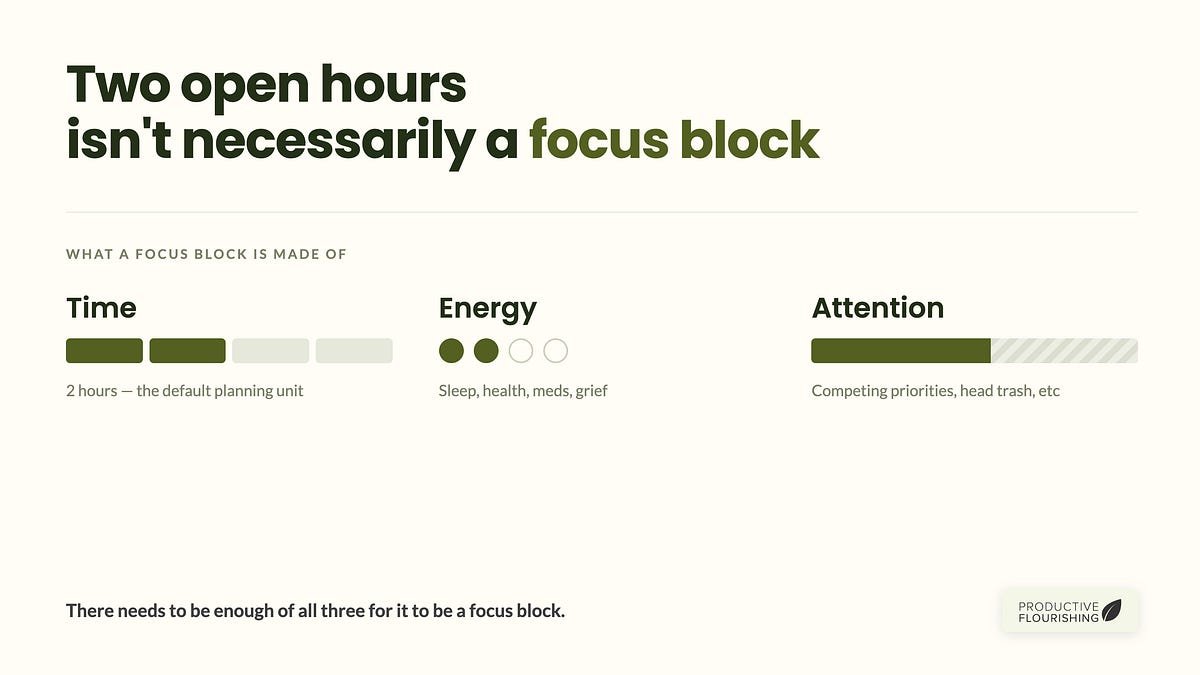
But the more critical components of focus blocks aren’t the time component. Energy and attention actually do more governing of whether it’s a focus block than time does.
The Two-Hour Rule still holds: two hours is the right size for a unit of creative work. But it’s a planning unit, and a planning unit needs to be put into a focus block. The clock can’t do that part — energy and attention do.
If you are your aging mother’s primary caregiver and she just fell, even if you’re just sitting at the hospital with two open hours and have the wherewithal for a focus block, it’s unlikely that you’re going to be able to do anything other than be there and use your energy and attention to take care of your mom and navigate the medical system.
If you’re having to switch to a new medication that’s messing with your cognition, energy, or hormones, that two-hour block of time you’ve labeled a focus block may not actually be a focus block.
If you’re worried about money, grieving, sick, or going through a divorce, you may be able to sit there for two hours, but your mind and heart are anchored to other things that likely matter more to you.
I can hear a lot of your head trash about how all of the above are just excuses and/or the Resistance. True professionals would be able to soldier through any of those. Plenty of people have done their best work throughout any of those conditions, so you should be able to, as well.
But let’s go back to the opening quote:
“On a full day, when everything lines up, when he has no obligations and nowhere to be”
Full day. When everything lines up. When he has no obligations and nowhere to be.
That set of conditions is rare for a lot of people, especially women and people of color. There’s always an obligation or self-expectation that operates as one, things often don’t line up, and full days are rare.
The craft part of being the professional very quickly becomes the easiest part of being a professional. Designing, iterating, and adapting your life and work to create the conditions where you can do your best work is the hard and ever-changing part.
This part is often overlooked and under-discussed. We see the work and results that mid- and late-career Creative Giants create and that’s the interesting stuff of podcasts, interviews, and so on. But it’s the mundane and boring parts of their life that are often just as important as their brilliance and mastery of their craft.
I’ll be honest that when I read Pressfield’s quote, I immediately latched on to the “two hours” part. With some of the things I’m working through, it was affirming.
It was only when I walked on it and thought about it more that I realized that the first parts I just highlighted were also important and worth amplifying for myself and others. I add them not to give us all cop outs, but to remind us that we’re not robots.
Whatever your work is, you know that it’s about putting the minutes and blocks in to make it happen. There’s nothing overly mysterious about it.
If your life is such that you can’t carve out enough focus blocks, that’s not a craft competency problem. If you’re reading this, it’s probably not a character problem, either. It’s much more likely that you have some competing priorities, head trash, and/or priority projects that you haven’t acknowledged as such.
Competing priorities, head trash, and unacknowledged priority projects eat your energy and attention. It’s displacement at play.
But just remember, even when you get things aligned and you create some focus blocks, you may not end up with full days where you can work on whatever you want. It’s probably going to come down to one or two focus blocks a day.
Looping back around, now you probably see why I suggest (at least) three focus blocks per week per project. It’s doable for a lot of us, a forcing function to make us get real about how many projects we can actually work on at a time, and sustainable over years.
If you design your life and work to get more focus blocks than that, great! But you’d probably surprise yourself if you put three focus blocks per week on your priority project for the next month. The Focus Block Planner and the Weekly Block Planner from the Free Planners page can help with this.
The next time you’re caught in the “if I were a real [Insert Blank Here], I’d have the time to do my best work” trap, remember that even Pressfield only gets two hours. What are you going to do with yours?
