

out to someone on LinkedIn I’d never met, asking what he thought was the best path into data engineering, and whether certifications were even worth pursuing. Turns out he’d already read one of my articles. So instead of giving me a fresh answer, he handed me back my own. “You’re on the right path,” he said. “You’re following the 12 month roadmap, stick to it. Don’t take suggestions from anyone, it might confuse you.”
I read that message twice. Because two weeks before that, I had nearly talked myself out of the very roadmap I’d publicly committed to.
Let me back up.
It’s been a month since I published my first article on this journey, “From Data Analyst to Data Engineer: My 12-Month Self-Study Roadmap.” Since then I’ve written three more, each one walking through something I built. An ETL pipeline from scratch. That same pipeline made production ready with SQLite and idempotency. Then scheduled with GitHub Actions, which turned into a lesson on portability before it became a lesson on scheduling.
Those four articles are a fair record of what I did this month. They are not a fair record of what the month actually felt like. So this one is different. No code, no walkthroughs. Just the parts that didn’t fit anywhere else.
The plan said one thing, the month did another
The roadmap laid things out in order. SQL first, then Python, then Git, then Spark, then Airflow, then Databricks. Tidy. Sequential. The kind of plan that looks great on a Notion board.
I didn’t follow it. Not really. Instead of moving through the stack in order, I built one small pipeline and kept pushing on it until it broke in new ways. SQL showed up. Python showed up. Git showed up. But not in the order I planned, and not because I scheduled it that way. They showed up because the pipeline demanded them.
I used to think that meant I was off track. Now I think it just means the plan was a starting point, not a contract. The roadmap got me moving. The pipeline decided what I actually needed to learn next.
The walls were never really about the tools
If you read the build articles, there’s a pattern I didn’t call out at the time. Every wall I hit had a technical fix and a non-technical lesson sitting underneath it.
- Idempotency wasn’t really about SQLite. It was about learning to distrust my own assumption that “it worked once” meant “it will keep working.”
- Persistence wasn’t really about Google Drive. It was about realizing my work could vanish the moment I closed a tab, and that I’d already lost a file once before without noticing how close I’d come to losing more.
- Portability wasn’t really about GitHub Actions. It was about discovering that one hardcoded path had quietly made my whole pipeline dependent on a single environment, without me ever deciding that on purpose.
None of those are coding lessons. They’re thinking lessons that happened to surface through code. That feels like the real shape of data engineering so far, at least from where I’m standing. The tools are how the lessons show up. They’re not the lessons themselves.
The part the build articles didn’t show
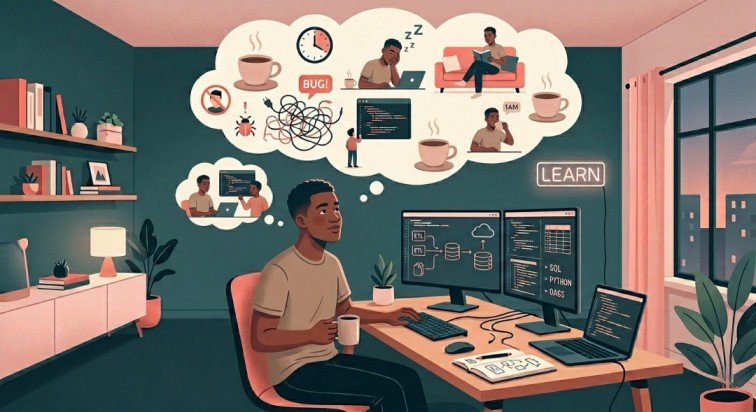
Here’s what they didn’t show. Somewhere in the middle of this month, the energy that came from people watching started to fade. Not dramatically. It just got quieter. I stopped feeling the pressure I wrote about in article two, the one where strangers reached out excited to follow along. That pressure didn’t disappear because I stopped caring. It faded because the goal at the end of it, landing a high paying data engineering role, started to feel far away. Far enough that it stopped being motivating and started being exhausting to even think about.
It didn’t help that my actual job got busier, and that I had to learn Laravel for work on top of everything else. Three to four hours a day sounds reasonable until you’re tired from your day job and the thing waiting for you at home is another unfamiliar stack.
There were stretches where I seriously considered slowing down. What kept me at the desk wasn’t the vision of the job anymore. It was smaller than that. I kept thinking about the one person out there who’s exactly where I was in May, stuck somewhere between analytics and engineering with no clear map, who might be waiting on the next article. Helping that one person became more motivating than the abstract idea of my own future role. I also made a point of looking for something genuinely challenging to fill my free time with, instead of the easy, mindless stuff that fills time without leaving anything behind. Even on the days the job felt far away, at least I wasn’t wasting the hours.
Almost getting pulled off course
I also have to be honest about something I called out before I even started this journey. In my first article I admitted to having shiny object syndrome, jumping between design, animation, marketing, IT, and now data, before any of them got the chance to stick. I said I’d need to be intentional to avoid that happening here too.
It happened anyway. Partway through the month I fell into a rabbit hole about certifications, whether I needed one, which one, whether I was even on the right path at all. That spiraled into seriously considering a pivot toward AI engineering instead, because in the moment it looked shinier and more in demand. I had to consciously stop and remind myself of the path I’d already chosen, and already told an audience I was committed to.
Which brings me back to that message.
The stranger who handed me my own advice
That LinkedIn message I mentioned at the start came right after that wobble. I’d reached out to someone for advice on the best path into data engineering, half looking for permission to second guess myself, half wondering out loud whether a certification would help. Instead he told me he’d already read my roadmap article, and that the answer to my question was sitting in my own writing. Stick to the plan. Stop collecting opinions from strangers, because too many opinions just confuse you.
There’s something almost funny about being talked back into your own plan by someone who only knew about that plan because I’d published it. But that’s the whole point of doing this in public. The accountability doesn’t only come from people watching you build. Sometimes it comes back around and hands you your own words at exactly the moment you need them.
What I actually learned about how I learn
The other realization this month had nothing to do with motivation and everything to do with how I work. I used to think I needed to build something big to actually learn anything. A real project, multiple weeks, something portfolio worthy from the start. That instinct nearly killed my momentum more than once, because big projects are easy to start and easy to abandon halfway through.
What’s worked instead is small. A pipeline I can build and break in a weekend teaches me just as much as a sprawling multi week project, and I actually finish it. Going into month two, I’m trading the idea of one big build for a string of small ones. Mini projects, sized to fit around a 9 to 5 and a Laravel deadline, each one aimed at a specific concept instead of a whole resume line.
Where that leaves me
If you’d asked me on day one what success looked like, I would have said the high paying role, full stop. A month in, that’s still somewhere in the picture, but it’s not what’s actually getting me to open my laptop after a long day at work anymore.
What’s getting me there now is smaller, and honestly more sustainable. I like building things. I like writing about what breaks. And every time someone tells me an article actually helped them figure out their own next step, that does more for me than the thought of some future job offer ever has.
The roadmap is still the roadmap. I’m still following it, cron job and all. But I’m starting month two with a clearer sense of what’s actually going to carry me through the next eleven, and it’s not the thing I thought it would be when I wrote that first article.
This is part of my ongoing series documenting my transition from systems analyst to data engineer. If you’ve been following along, thank you. If this is your first article in the series, the earlier ones are linked above.
Connect with me on LinkedIn, YouTube, and Twitter.
