

The biggest car news and reviews, no BS
Our free daily newsletter sends the stories that really matter directly to you, every weekday.
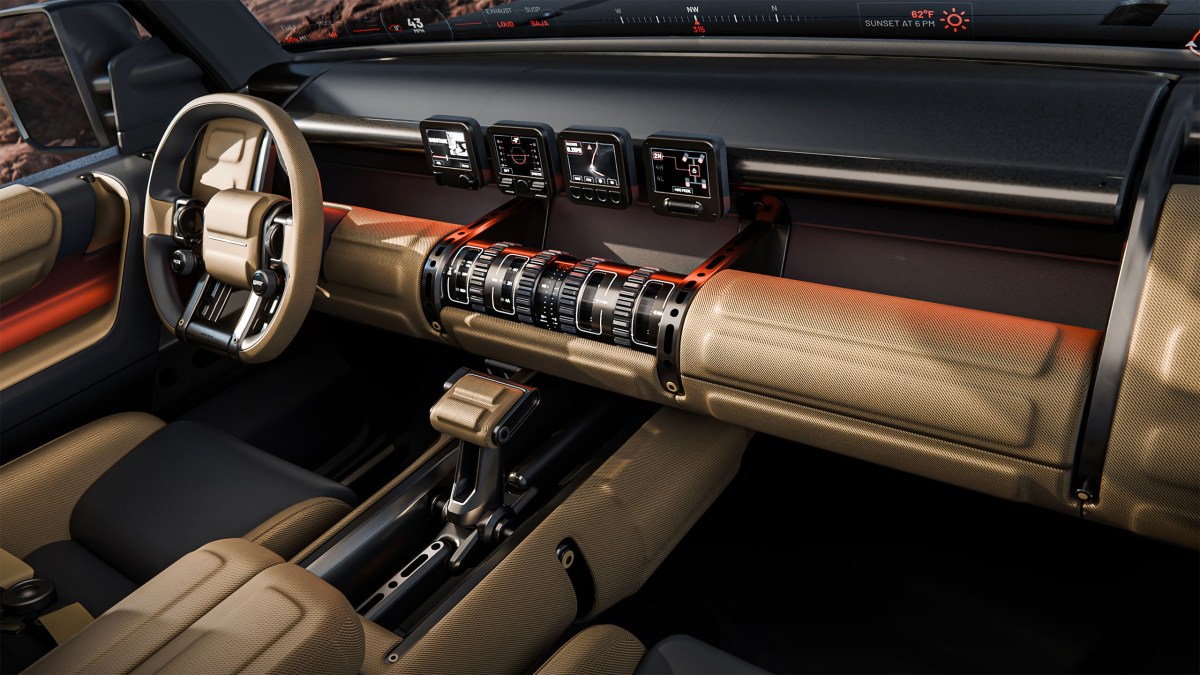
Today in New York, Hyundai pulled the cover off a concept SUV intended to illustrate the direction of its future body-on-frame offerings designed and built in and for the U.S. That vehicle is called the Boulder, and, to be honest, all I see in its exterior design is 2004 Ford Bronco concept with a heap of Scout thrown in. That’s a topic for another blog, though, because here I want to focus on the Boulder’s interior, and how it’s anticipating the imminent arrival of Cyberpunk car interiors.
If the Boulder’s cabin looks familiar, that’s because it’s a slightly softer development of the interior from last fall’s Crater concept. The dash has the same “Bring Your Own Device” rail system for what look to be movable gauges and screens, with a cylindrical dash below stacked with big vertical meters and huge, chunky rotating dials. The difference is that the Boulder uses some more materials that a real car would, like textiles and padding. The Crater’s metal dash would probably be an injury risk in a crash, but who am I to say?
The thing is, the automotive industry is finally in a place where designs like these are less theoretical and genuinely possible. Buttons and other physical controls are, as we know, very much back in. Hyundai has said as much about its own future offerings. On the Boulder’s dash, from left, we see settings for diff locks, four-wheel-drive modes, something that might be called “X TREK” (the blurry rendering makes it a little hard to parse), and possibly also dynamic stability control. Sandwiched between them is a compass, and next to every vertical display is one of those gear-like crowns. The Crater had slid a row of climate control toggles below those, like most modern Hyundai and Kia products have, but the Boulder lacks these.
At top, the dashboard of the new Boulder concept. At bottom, the dash of last year’s Crater concept. Hyundai
It’s a slick design that allows the Boulder to proudly wear its rough-and-ready proclivities on its sleeve. And what’s especially interesting is, rather than place a big touchscreen front and center, Hyundai’s gone the direction of tinier, modular screens that can ostensibly be added, removed, or rearranged in the owner’s preference.
My old colleague Peter Holderith tipped this off a few years ago, actually—that automakers should stop trying to cram every feature into one megascreen and portion them out into localized panels that group similar functions together. One of my favorite examples of this is the Lucid Air’s lock and lights panel, which sits just to the left of the instrument cluster. The Boulder (and Crater) take this idea and truly go to town with it.
Look at those hollow vertically rotating dials in the steering wheel. Probably not production-feasible, but really cool looking! Hyundai
The screens show currently playing media (hell yeah, “Sabotage”), an inclinometer, a map, and a closer view at the activity of the 4WD system. Personally, I’d love to imagine a world in which Hyundai sold a selection of these, and owners could option the ones they prefer for their vehicles. People tend to actually dig technology in their vehicles, so long as they have some agency over how it’s incorporated, and such an initiative could achieve that. There’s also a very lightweight heads-up display running the length of the windshield, which looks cool, though we’d have to see how readable it’d actually be in practice.
Taken altogether, the Boulder and Crater before it are very futuristic, but not in that austere, soulless, minimalist-to-a-fault way that car design was chasing throughout the last decade and into this one. It’s a sign that Hyundai, and I’d expect many other automakers, are genuinely trying to find a way to make technology and tactility coexist in a pleasing way, rather than steamrolling everything with huge screens and frustrating capacitive buttons. The Cyberpunk aesthetic has informed the exteriors of many of Hyundai’s recent offerings, but it finally seems about ready to enter the cabin.
Hyundai
Got a tip? Reach out to tips@thedrive.com
Backed by a decade of covering cars and consumer tech, Adam Ismail is a Senior Editor at The Drive, focused on curating and producing the site’s slate of daily stories.
