

The biggest car news and reviews, no BS
Our free daily newsletter sends the stories that really matter directly to you, every weekday.
Sometimes, a hybrid system can seem like the worst of both worlds. That goes double for plug-in hybrids, which not only take on electric motors and inverters, but heavier batteries designed to store enough energy to propel a car on electric power alone. A PHEV is essentially two redundant drivetrains mated together in parallel—a potential efficiency nightmare. But clever engineers can find ways to exploit or eliminate those redundancies to the benefit of both the manufacturer and the end customer.
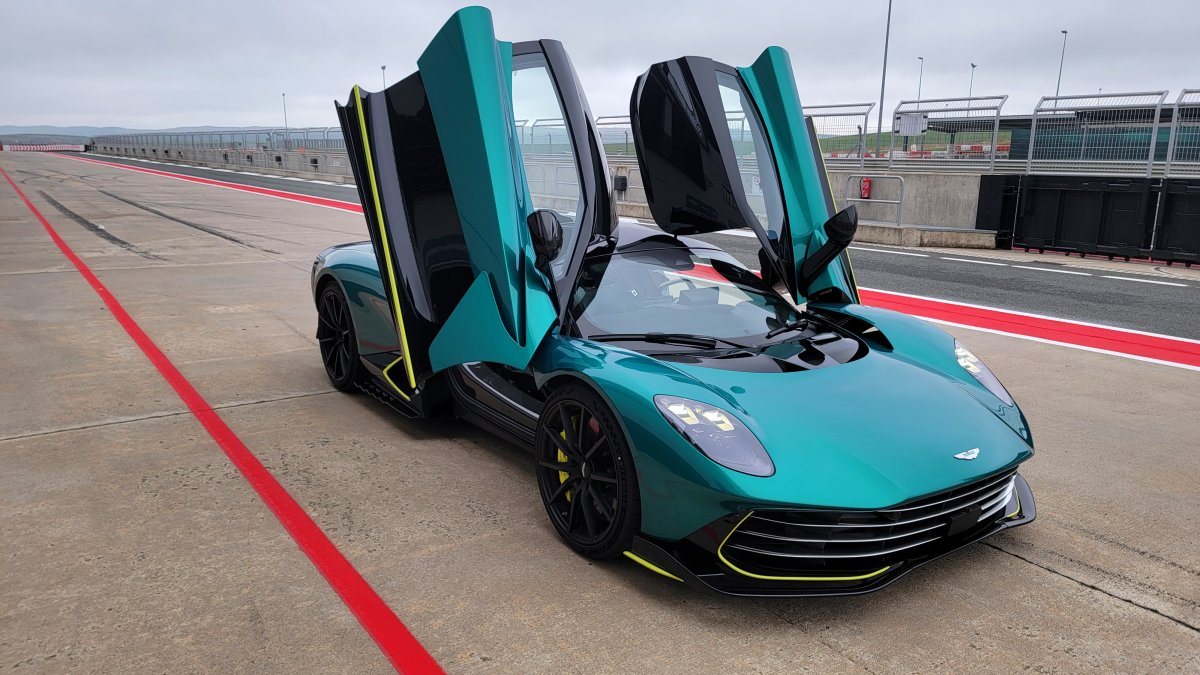
Take the new 2026 Aston Martin Valhalla. Its 4.0-liter, twin-turbocharged, flat-plane crank V8 is mated to three individual electric motors. Two of them sit on the front axle, each independently driving one of the front wheels. This not only enables truly dynamic front-axle torque vectoring, but it also provides Aston Martin’s engineers with the unique opportunity to bypass a conventional reverse gear in favor of a clever alternative.
Those two electric motors up front effectively form a remote e-axle; there’s no physical center differential or output shaft connecting them to the gearbox behind the mid-mounted V8. When the driver selects reverse gear, the Valhalla simply puts the gearbox in neutral and spins the front motors in reverse. And yes, this works when the battery is “depleted” so long as the car has enough fuel to run the gas engine, which can act as a generator. Realistically, this won’t happen; the Aston’s battery is regularly replenished by regenerative braking.
Aston’s engineers also found a couple of clever ways to exploit redundancies offered by the presence of both an electric motor and the dual-clutch transmission on the Valhalla’s rear axle. We already touched on the absence of a physical reverse gear and the fact that the Valhalla’s third electric motor is integrated into the gearbox. This arrangement also exploits an engineering quirk (or feature, one might argue) of dual-clutch gearboxes. In fact, it’s right there in the name.
Describing the operation of a DCT practically requires its own language, but for our purposes, you only really need to understand one thing: no matter what gear you’re in, both of a DCT’s internal shafts remain engaged on the output side at all times; the clutches transfer the power coming from the engine between the two shafts carrying the even and odd gears, respectively. This is a big contributor to how quickly they can shift gears. Whether you’re shifting up or down, you’re always going from even to odd or vice-versa.
To save space and weight (and again, reduce unnecessary redundancy), the Valhalla’s rear electric motor engages only on the even gear shaft. Because both the even and odd shafts are always engaged on the output side, this means you have electric assist no matter what gear you’re in. And unlike most pure EVs, Aston’s choice to permanently engage the electric motor on the mechanical rear axle means that it benefits from the same torque multiplication as the gas engine’s output. That means the motor can be much smaller for the desired final torque output. It also means that only the even gears need to be reinforced to carry the additional torque of the electric motor. Sounds simultaneously elegant and nightmarish to engineer, does it not? But I can attest to its seamless execution.
When our very own Kyle Cheromcha drove the 2027 Ferrari 849 Testarossa earlier this year, he summed it up quite nicely: Don’t fear the future. With stuff like this, why would you?
Got a news tip? Let us know at tips@thedrive.com!
Byron is an editor at The Drive with a keen eye for infrastructure, sales and regulatory stories.
