

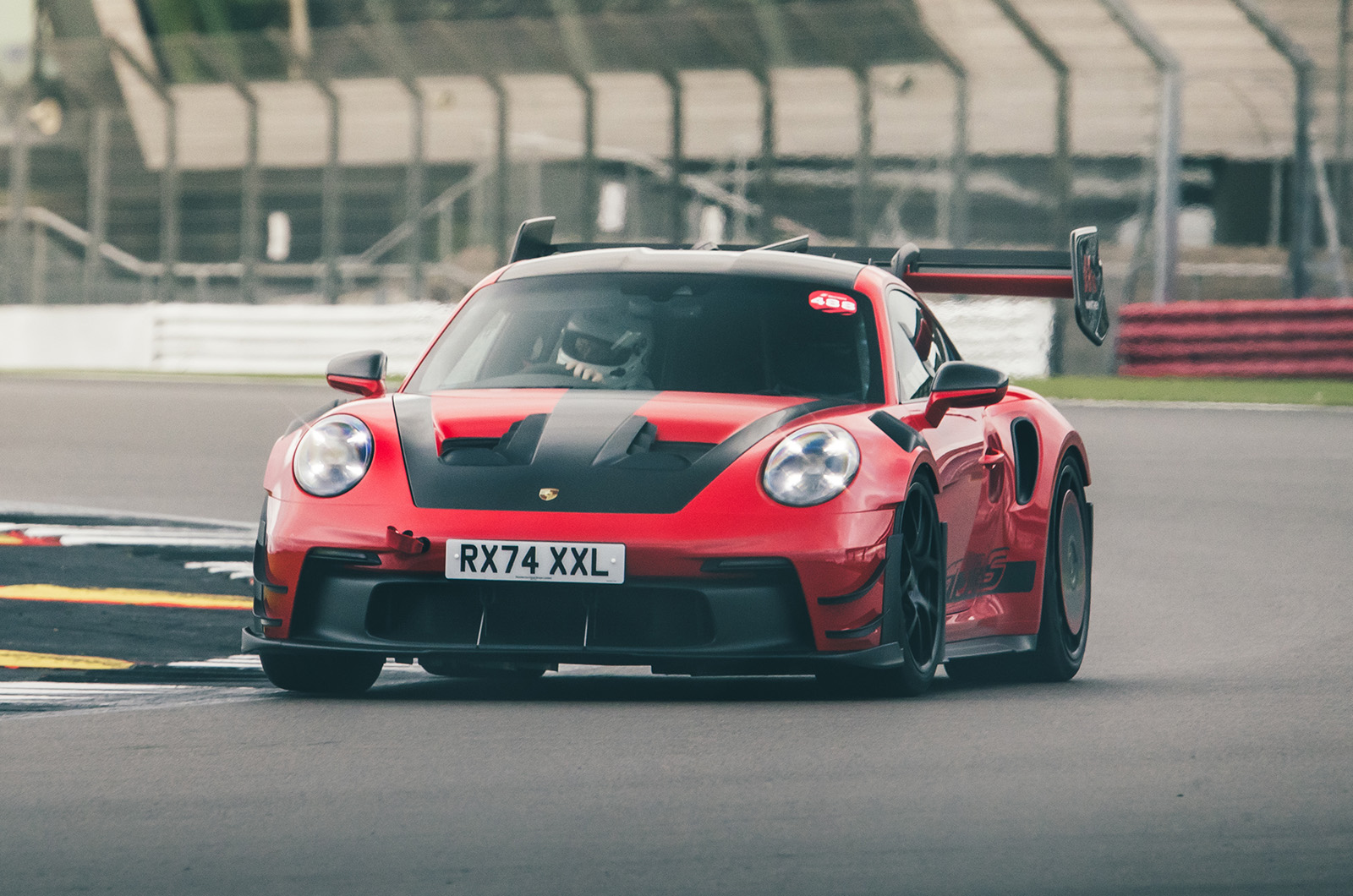
In the end, it puts in a 2min 11.15sec lap – 1.95sec quicker. Checking over the telemetry, the Manthey’s advantage is in its ability to carry a couple of extra miles per hour on the exit kerbs of faster bends like Farm, and carry more speed into the rollercoaster Maggotts-Becketts sequence. Outright braking distances aren’t notably shorter, interestingly.
Clearly the Manthey allows you to draw more speed to the apex. During huge sweeping bends, where your senses are on red alert for the early signs of grip eking away at either axle, it also simply holds on a little longer. And perhaps, for the amateur, it just encourages you to try wilder things, more of the time.
Would a professional have squeezed more or less time from the kit? The sliver of extra confidence the Manthey 3RS seems to give you, so useful to the amateur, would matter to them less. On the other hand, a pro driving on the true limit of adhesion would maximise the Manthey’s downforce advantage everywhere. Next time round we’ll have to give Jörg Bergmeister a call, but today, two seconds on a full grand prix circuit, in similar conditions and on the same rubber? That counts as daylight. Just over £50k per second is a mad premium, admittedly, and a better example of diminishing returns you won’t find.
I’m sure Manthey, pressing its spectacles up onto the bridge of its nose, would argue that you’re getting a different machine from the regular car in subjective terms, not just a quicker one. I’d absolutely agree – the Manthey feels more animal. In the world of official factory efforts, you’re also getting no less than the most extreme track-day 911 in history, which for plenty of people will feel priceless.
