

The biggest car news and reviews, no BS
Our free daily newsletter sends the stories that really matter directly to you, every weekday.
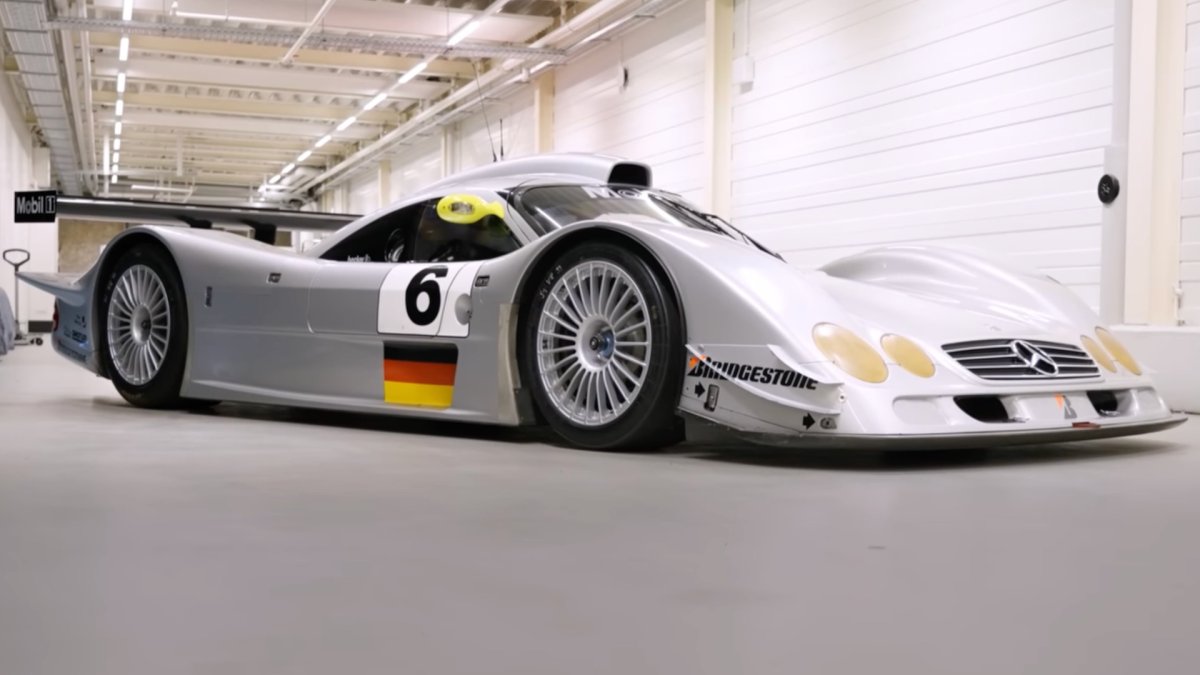
The Mercedes-Benz CLR is remembered for all the wrong reasons. It infamously took flight, not once but three times at the 1999 24 Hours of Le Mans, flipping end over end and soaring right over crash barriers like something produced by a broken video game physics engine. YouTuber Mike Fernie recently visited one of the surviving cars—now part of the Loh Collection in Germany—and explains its full story in a detailed video.
The CLR was the result of an evolutionary process that began with the CLK GTR and CLK LM. Those cars were built to the GT1 ruleset that defined the top class of endurance racers in the latter half of the 1990s, and mostly produced race cars masquerading as street cars. The CLR was built to LMGTP rules, which represented a tilt back toward dedicated prototype race cars and let Mercedes dispense with the road-car pretension.
Mercedes kept the CLK LM’s V8, but increased displacement from 5.0 liters to 5.7 and wrapped it in more snug bodywork. The familiar four round headlights and grille from the then-new C215 CL-Class coupe are mounted ridiculously low on the front end, and the bodywork droops down below the wheel arches. That bodywork, with long front and rear overhangs to accommodate big diffusers and run with very little rake, would turn out to be the CLR’s undoing.
Mike Fernie via YouTube
The V8 was loosely based on the M119 road-car engine, which, in turbocharged form, had powered the Sauber-Mercedes C9 to victory at Le Mans a decade earlier. It made about 600 horsepower in the CLR, enough to turn this car into an airplane.
While Mercedes claimed to have conducted over 20,000 miles of testing, the three cars it brought to Le Mans had trouble on the Circuit de la Sarthe’s high-speed straights. Future F1 driver Mark Webber took off during qualifying, then again during a pre-race warmup. In his autobiography Aussie Grit, Webber says team management didn’t take his crashes seriously (they weren’t caught on film), hence why he was sent back out, and why Mercedes didn’t withdraw.
The two undamaged cars took the start, although Mercedes made some tweaks (with input from Adrian Newey) and advised its drivers not to follow other cars too closely at high speeds. That wasn’t enough to prevent Peter Dumbreck’s crash during the race itself—one of the most replayed moments in motorsports.
I Found The Flying Car Mercedes Has Hidden Since 1999
That moment was caused by a lack of balance in downforce between the front and rear ends. The low-rake setup took downforce off the front end but the fixed rear wing didn’t bring a corresponding reduction at the back. That caused the front end to pitch up on the bumpy Circuit de la Sarthe, allowing more air to get underneath and push the front end higher, while the rear wing kept pushing down on the back of the car. The wake from a car in front made things worse.
Just as no battle plan survives contact with the enemy, the cleverest ideas of engineers don’t always work in the real world. Aston Martin and Honda are getting a painful reminder of that in F1 right now, although at least the nerve-jangling AMR26 hasn’t taken flight.
Stephen has always been passionate about cars, and managed to turn that passion into a career as a freelance automotive journalist. When he’s not handling weekend coverage for The Drive, you can find him looking for a new book to read.
