

The biggest car news and reviews, no BS
Our free daily newsletter sends the stories that really matter directly to you, every weekday.
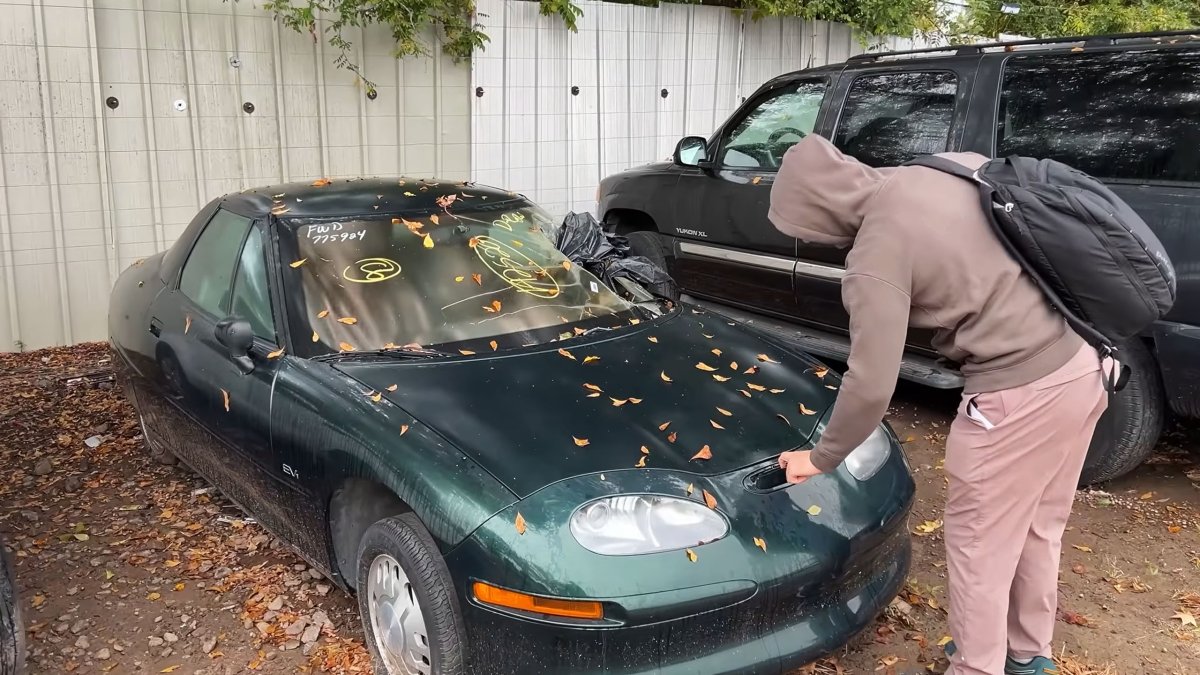
In October, we shared news that all lovers of weird, forgotten cars were buzzing about: That someone had purchased a General Motors EV1 from a court order sale for the eye-watering sum of $104,000 with the intention of giving it a full restoration. If you know about the EV1, you know why this was such a huge deal: GM never sold these cars; they were leased to owners during the two model years they were built, 1997 and 1999, recalled back to the company starting in 2003, and then most were unceremoniously crushed. A few survived, however, like this one—VIN 212—and GM has even agreed to participate in its restoration. What’s going on?
YouTube channel Questionable Garage is documenting every step of the restoration journey. (They’re not to be confused with the other YouTube channel that initially made waves with this car; it appears multiple channels may be participating in #212’s rebirth.) The news got GM’s attention, which led to an invitation to visit the company’s Global Technical Center in Warren, Michigan, to check out some of its other important EV landmarks throughout history and chat with GM President Mark Reuss.
We, like many, have been curious about the change in corporate tune. Sure, EVs are now a part of GM’s core brand in a way they obviously were not 20 years ago. Yet, even in the days of the Volt, and then the Bolt—and even though the EV1 was an achievement you’d reckon any brand should be proud of—the automaker has rarely gone out of its way to acknowledge it. It’s with these thoughts swirling that I put the question to the company: What inspired the decision to get involved now? Here was the PR team’s official answer:
“We’re proud to support this project and excited to watch it unfold. The EV1 represents an important chapter in electric vehicle history and in the broader evolution of EVs. Supporting the restoration of V212 reflects our commitment to preserving that legacy and recognizing the engineers, designers and innovators who helped pioneer early electric mobility. When we saw the passion that Billy, Jared and the Questionable Garage team were bringing to this restoration, it felt like exactly the right moment to lean in, because the spirit of innovation that drove EV1 is the same spirit driving our EVs today.”
That response, while refreshing and coming in with the right attitude, doesn’t necessarily explain the change in heart. But we have a little more insight. A source with knowledge of the situation told The Drive that “New leadership over in marketing and communications had a lightbulb moment and convinced Mark Reuss it was a good opportunity to tout history. The old regime wanted to bury it and never wanted to talk about it.”
Photos of a GM EV1 being driven and recharged from way back in 1998. David Butow/Corbis via Getty Images
Another individual, formerly involved with the EV1 project, told us that they didn’t expect the sudden about-face.
“I was as surprised as anyone, not only did all this happen, but then GM published it on their own page,” they said.
This person noted that EV1 communities on Facebook and Discord are “going nuts,” especially given the timing of this, around the 30th anniversary of the car’s production start and 20th anniversary of the documentary Who Killed the Electric Car? They offered another tidbit to really couch the massive shift in strategy.
“Historically, when Washington State University brought a donor car to an event, GM threatened to take away the car,” they added.
The latest episode of Questionable Garage’s series begins with the Reuss interview. I won’t spoil it—you should go listen to the whole thing yourself—but Jared, the channel’s host, and Billy, the EV1’s owner, start by asking Reuss why he’s so interested in their project.
The executive mentions a personal attachment to the EV1 because his father was involved in its creation, and says that he’s wanted to rescue random examples that have popped up in the past. He also centers on one piece of paperwork Jared and Billy came across during the sale. In Reuss’s words:
“One of the coolest moments in the show for me, because I had never seen it, was the actual sheet of paper that went with those cars we donated, which—I didn’t know that. It says, ‘We will not ever help you get one back on the road, we won’t help you do this, we won’t help you do that.’ It’s like, wow, this is a company that wasn’t really fired up to continue anything around this, we’re gonna have to scrap ’em, right? And so it was—I get it from a legal standpoint. But that was really what drew me into it.”
Later on, Reuss does reflect on regulations and the perception of GM in light of the EV1 saga. It isn’t exactly revelatory, but that’s kind of how this was always destined to go, the moment that GM finally decided to stop publicly disowning the car.
An excerpt from a legal document passed along with EV1s that were donated or otherwise preserved, saying the new owner must agree to never drive the vehicle, and it may be used for “educational or exhibition purposes only.” The Questionable Garage via YouTube
What took them so long to come around? Maybe there was some shame. Maybe it was the simple awkwardness of not knowing how to broach the topic—not knowing how to send such a message, after the seemingly extreme lengths decision-makers chose to go to burn away that part of the company’s legacy decades earlier. Those are only guesses, of course, and maybe one day, better answers will prove them out or debunk them. For what it’s worth, former GM CEO Rick Wagoner did once consider killing the EV1 project his worst decision. “It didn’t affect profitability, but it did affect image,” he told MotorTrend already in 2006.
What we do know is that Reuss and company are committed to doing what they can to assist #212’s restoration. “Whatever you need, we’ll help. We will,” GM’s president says near the end of the interview. “And if we can’t, we’ll tell you we can’t. But it won’t be because we don’t want to—we might have the same problem you do,” speaking to the challenge of resurrecting a car with antiquated, highly specialized electronics and software. It seems that at least the guys were able to source the windshield and quarter glass they needed from GM, which, in itself, is a monumental assist for the preservation of the only EV1 ever legally sold.
Passionate enthusiasts and activists organized a vigil for EV1s sent to the crusher that spanned weeks, back in 2005. Mel Melcon and Luis Sinco/Los Angeles Times via Getty Images
Got a tip? Reach out to tips@thedrive.com
Backed by a decade of covering cars and consumer tech, Adam Ismail is a Senior Editor at The Drive, focused on curating and producing the site’s slate of daily stories.
