

Do you want to know something deeply disheartening? The American performance wagon does not exist anymore. It’s been more than a decade since the last one was offered and — at least as of 2026 — there are no plans for a comeback.
While there are Americans who love wagons, the average consumer seems to be convinced that an SUV is a better choice because it has more room and being higher off the ground is safer. Little do they know that some wagons can carry just as much and taller vehicles don’t necessarily provide safety benefits for passengers — although they do increase danger for those they crash into.
We could write a dissertation on the psychology behind the death of this body style and why the long-dead wagons deserve a resurrection, but we won’t. Instead we’re taking the celebration of life path and looking back on some of the greatest muscle wagons ever put into production — specifically, we’re looking at American or American-adjacent wagons that have a V8 and a genuine cool factor. Oh, and they have to be able to do a burnout.
Cadillac CTS-V Sport Wagon
The Cadillac CTS-V Sport Wagon was the last we saw of a modern Cadillac wagon, debuting for 2011 during the second-generation CTS and leaving in 2014. What’s crazy to us is that even back then, 15 years ago when it debuted, magazines were shocked that a hot, fast wagon like the CTS-V existed with how small the market share was for that body style. But Cadillac, bless it, sacrificed sales in favor of enthusiast brownie points.
In addition to the Sport Wagon’s extra sheet metal, the CTS-V’s other primary point of interest was the supercharged 6.2-liter V8 under the hood and the six-speed manual transmission option — part of the reason why CTS-V wagons are still so expensive. The particular motor was GM’s LSA engine, which was used for the first time in the second-gen CTS, and would soon find its way into the business end of the Camaro’s lineup with the ZL1. In CTS-V trim, however, the LSA produced 556 horsepower and 551 pound-feet of torque — enough to scoot the station wagon from 0-60 mph in 4.3 seconds and through to the quarter-mile in 12.6.
To keep all that get-up between the lines, Cadillac fitted the CTS-V Sport Wagon with big sticky Michelin Pilot Sport PS2 tires, Brembo brakes, and magnetic dampers — basically, everything that came on the coupe and sedan versions. Of course, what those two didn’t have was 58 cubic feet of total cargo space and a sexy long-tailed roofline.
Dodge Magnum SRT-8
The mid-to-late 2000s experienced a muscle car boom from the Big Three not seen since the 1960s. Ford launched the S197 Mustang in 2005, Chevy was getting ready to debut the 5th-gen Camaro, and in the span of about two model years, Chrysler brought back the Charger and Challenger (2006 and 2008, respectively), both of which were coming off a decades-long hiatus from the production line. Of the three, though, only Chrysler expanded beyond the traditional muscle car business to deliver the Dodge Magnum SRT-8 — one of only two 21st-century American muscle wagons.
The Magnum model debuted in 2005 with the SE and SXT trims offering a 2.7-liter V6 (190 hp), a 3.5-liter V6 (250 hp), and the range-topping R/T packing a 340-horsepower 5.7-liter Hemi V8. In 2006, the SRT-8 finally hit the streets. The 5.7-liter, while already powerful enough for this family wagon, was child’s play in Dodge’s eyes, and as such, the new king of the Magnum hill would receive a 6.1-liter Hemi capable of a very healthy 425 horsepower and 420 pound-feet of torque.
The 6.1 was the result of a bored-out 5.7 Hemi with stronger rods, an upgraded block, new cylinder heads, a forged crankshaft, as well as a billet camshaft and lighter valves. For the price of about $38,000 in 2006, the SRT-8 also came from the factory with big Brembo brakes, beefier (and lower) suspension, a quicker steering rack, a Mercedes-sourced five-speed automatic gearbox, and subtle yet functional cosmetic modifications, particularly at the front end. The whole party ended after 2008, as you could imagine, but 20 years later the Magnum SRT-8 still stands the test of time.
1991-1996 Buick Roadmaster Estate Wagon
The Roadmaster was Buick’s full-size, luxurious land yacht that became the brand’s flagship for most of the ’50s. However, the nameplate disappeared after 1958 as Buick decided to focus on other models, and wouldn’t be seen again until the early 1990s when GM decided to resurrect it with the Roadmaster sedan and the Estate Wagon.
The new Roadmaster was a direct sibling of the contemporary Chevy Caprice, sharing underpinnings and most of the exterior design. Speaking of the exterior, one of the most endearing characteristics of the Buick Roadmaster Estate Wagon was not necessarily its V8 but its sheer size. These are extremely long cars, even by today’s standards. At about 217 inches bumper to bumper, it outstretches a 2026 Mercedes S-Class and the newest Chevy Tahoe. This exceptional length contributed to its enormous cargo capacity and helped make it one of our readers’ favorite family cars of all time.
Now onto the engine. It originally had a 170-horsepower 305 cubic-inch V8, but by 1992, power was up to 180 with the 350 c.i. V8. In its final couple of years from 1994 to 1996, the Corvette’s LT1 V8 was made available, albeit with iron heads instead of aluminum and a different camshaft. It made 260 horsepower and helped drive the extra-long Buick to decent sales. While 260 horsepower and 4,500 pounds of wagon aren’t a particularly quick combination, in the 1990s, it was among the only decently powered American wagons since the CAFE regulations hit in the 1970s. In our books, that means that the Roadmaster counts as a legendary muscle wagon.
1973 Chevrolet Chevelle Malibu SS Wagon
For the 1973 model year, GM’s A-body cars received something called the Colonnade body style. This meant that the new class of car had fixed, structural B-pillars, quarter windows, and would no longer be offered as convertibles. To GM, this meant that new and existing models would be mixed around in the lineup to fit this new order.
One of the models affected by these changes was the Malibu, which still had its top trim SS variants on the new Colonnade bodies. However, it would also be made available as one of the rarest wagons ever made by the Big Three — for 1973 only, interested customers could purchase a Chevelle Malibu SS Wagon.
This obscure muscle wagon was already completely rad on the surface, and its engine options were the cherry on top. The SS package came with a standard 350 cubic-inch V8 rated at 175 horsepower, although truly wacky folks could also check the box for the legendary 454 c.i. V8. Since it was 1973, though, the big-block made only 245 horsepower, which isn’t exactly CTS-V levels of brawn, but was far better than what was to come during the rest of the decade. Another factoid we love about this car is that, according to Hagerty, only 71 wagons were ordered with the SS package and the 454 V8 option. Whoever those 71 people were, we’d like to shake their hands.
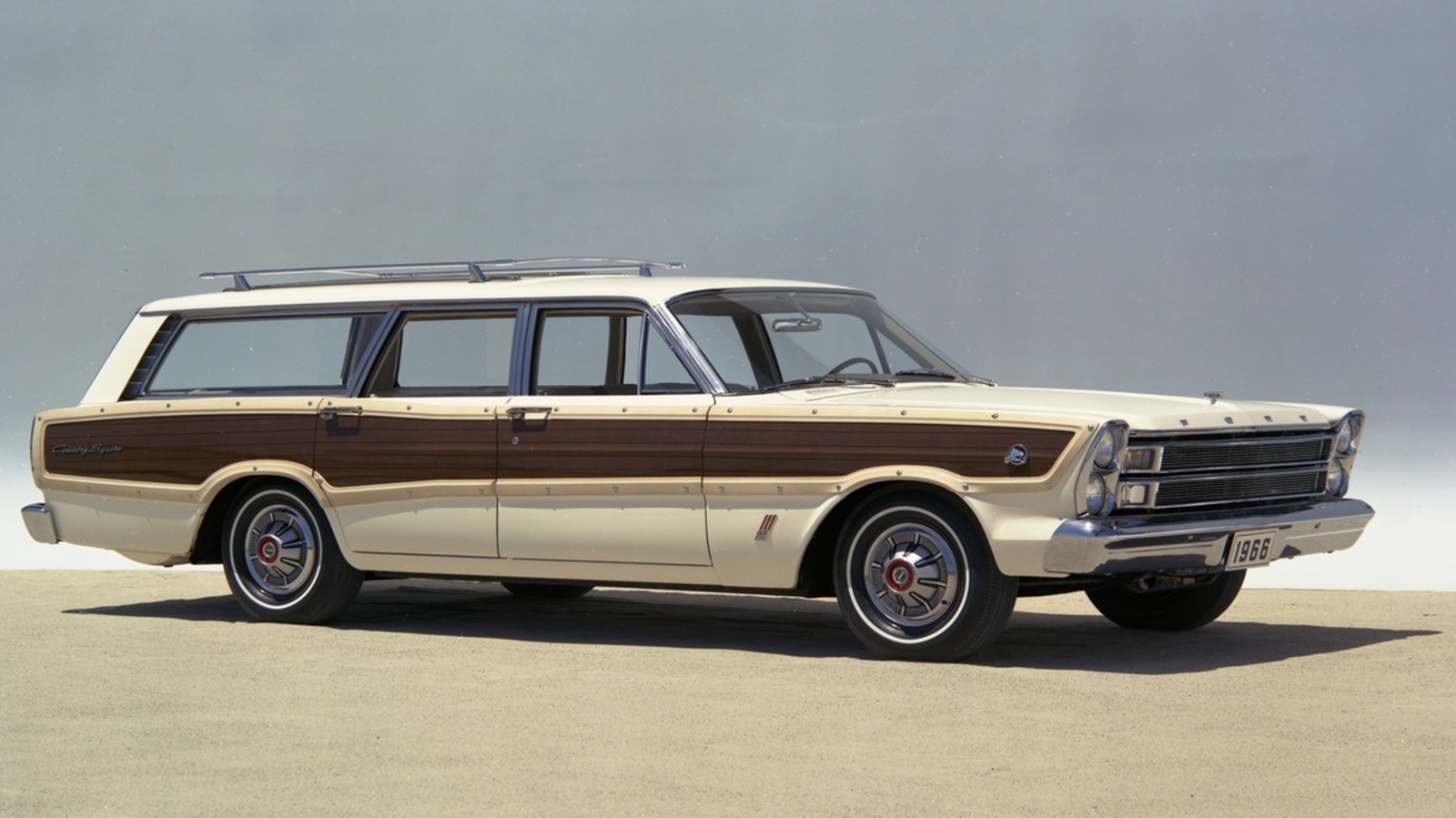
1966-1968 Ford Country Squire Wagon
The Ford Country Squire wagon first appeared in 1950, when Ford started using the term “Country Squire” to describe its flagship station wagons. Early Country Squires only had two doors, but by 1952 the Squire had morphed into the classic four-door version of the model we’re familiar with today.
Country Squire wagons were in production for more than 40 years, ending with the LTD-based Country Squire wagons in 1991. Of that four-decade-long run, arguably the most fascinating example came in the 1960s, when those who wanted big power in their station wagons could opt for a Q-code, 345-horsepower 428 V8. Sadly, there aren’t many accounts of people actually doing this — possibly because you would have to special order it through a dealership, or perhaps because family car buyers didn’t usually want or need the big-block.
However, Hagerty has shared the story of at least one well-documented example of a 1967 model that was featured on the Barn Find Hunter series. In this case, the buyer told the dealer he wanted a Country Squire with the 428 V8, a four-speed manual, bucket seats, and a center console. The buyer was told he could only get the 428 with an automatic, or the three-speed manual with a 390 V8.
After some convincing, the dealer put the gentleman in contact with none other than Lee Iacocca himself, who, car guy that he was, approved the build sheet himself and gave that man the world’s only 428-powered four-speed Country Squire.
1966-1972 Dodge Polara Station Wagon
Oliver Hoffmann/Shutterstock
You probably don’t think of the Dodge Polara as often as a Charger, Coronet, or Challenger, but the Polara was also an important part of Dodge’s muscle car frenzy throughout the 1960s. A combination of wild rear fins, dramatic body lines, and eye-catching colors defined the first two Polara iterations, which were made from 1960 to 1964. Soon after, the Polara would be promoted as Dodge’s base full-size C-body offering, opening up many new possibilities for the model.
One of those possibilities came along in 1966, when Chrysler unleashed its 440 cubic-inch V8 onto the market, changing the big-block game and further fueling the horsepower wars. As a full-size C-body car, the Polara also came in station wagon form and had since its 1960 debut, meaning that starting in 1966, the Polara Station wagon could be factory equipped with the 440, which produced 350 horsepower and a monstrous 480 pound-feet.
As far as we know, there weren’t any special C-suite interventions that occurred with the Polara, so all of them likely came with the factory three-speed TorqueFlite automatic unit that was standard across many Chrysler products of the time. This muscle wagon combination was available all the way until 1973, when the Polara was phased out in favor of the existing Dodge Monaco.
1969 Chevrolet Kingswood Estate
When one of the Big Three debuts a successful product, the others will always want to throw their hats into the ring — it’s an automotive industry rule as old as the U.S. auto industry. So, when Ford’s fancy Country Squire wagon proved its viability at dealerships, you wouldn’t be surprised to know that Chevrolet wasn’t too far behind, debuting the new Kingswood wagon for the 1959 model year. It would only last through 1960 before being shelved for other projects, but eight years later, as the 1970s approached, Chevy reconsidered the Kingswood concept.
In 1969, it returned. Now based on the Caprice, the top-of-the-line Kingswood Estate wagon went all in on the full-size family experience, featuring wood paneling, rear-facing third row seating, and features like headlight washers, an engine block heater for cold starts, and a dual-action tailgate. Aside from those amenities, though, the Kingswood may have taken the whole muscle wagon thing more seriously than any other ’60s or ’70s wagon we’ve featured thus far.
For the 1969 model year, you could get one straight-six, a 327 V8, a 350 V8, a 396 V8, and even two versions of the 427 Turbo-Jet V8. The most powerful advertised version of the 427 pumped out 390 horsepower and 460 pound-feet of torque. Driven by a three-speed automatic, the Turbo-Jet-powered Kingswood was easily among the quickest station wagons of its time. Reportedly, there was also a special COPO L72-code 427 V8 available for the Kingswood with 425 horsepower, but even without that mystery option, the Kingswood is the quintessential horsepower-era muscle wagon.
1966-1970 Dodge Coronet Station Wagon
Gestalt Imagery/Shutterstock
In the mid-to-late 1960s, Dodge brought back the Coronet name after a relatively quick five year break in production from 1960 to 1964, but not before making a slight miscalculation. Chrysler believed that General Motors was planning to downsize its full-size cars into a smaller, more intermediate class of automobile. Turns out, this information was false, meaning that for a few years in the early 1960s, Dodge’s full-size cars were rather pathetic-looking compared to the larger Fords and GM products.
To salvage this mistake, Dodge ended up utilizing much of the engineering from this awkward full/medium size platform to create a purpose built mid-size platform, which would give rise to the all-new 1965 Coronet. This streamlined family car came in all shapes and sizes, including coupes, sedans, and of course, station wagons. The Coronet, somewhat confusingly, used triple-digit numbers as trim level designations like 440 and 500 (eventually there were also Deluxe and R/T trims available), meaning your car could be named Coronet 440, and come with a tiny 273 c.i. V8.
While the Coronet Station Wagon wasn’t regularly seen with a 426 HEMI, it was occasionally seen with another formidable big-block — the 383 c.i. V8. The high-output version of this motor used a better 10.0:1 compression ratio, a four-barrel carburetor, dual-exhaust system, and a dual-snorkel air-cleaner, allowing for 330 horsepower and 425 pound-feet of torque. So, even with nine of your friends or kids in the back, the Coronet wagon seriously scooted, and according to road tests, the 383-equipped wagon was only a second slower in the quarter-mile than a 440-powered Coronet R/T coupe.
1955-1957 Chevrolet Bel Air Nomad
The Bel Air Nomad is kind of the muscle wagon that started it all. It began as a Motorama show car in 1954 using many parts from the recently debuted Corvette, but it wouldn’t hit the production line until 1955. It used the same running gear as every other ’55-’57 Chevrolet car, but the engine option that made it a true muscle wagon was the new-for-’57 283-cubic inch V8, which made either 250 or 283 horsepower depending on options.
While the Nomad was an early part of a wave of growing wagon popularity in the 1950s that would peak in subsequent decades, it didn’t last long. After 1957, the Bel Air Nomad as we knew it was gone, although the name was used a few more times in subsequent decades for different, less imaginative cars. It wouldn’t end up being a particularly popular choice either, only selling around 22,000 units for its three year run.
Some 70 years later, though, its popularity is a different story. According to Hagerty, even a less powerful 265 V8-powered Nomad is worth more than $53,000 in “good” condition, and up to $85,000 in “concours” condition. The factory high-output 283 V8-powered examples are even crazier, ranging from $85,000 in “good” condition up to more than $140,000 for a “concours” level car.
Honorable Mention: Holden Commodore SS-V Redline Sportwagon
As a quick end to this piece we’re including the Australian-built Holden Commodore Sportwagon because it’s basically a Chevy SS underneath. However, an important distinction – the Chevy SS we love so much wasn’t the blueprint. Instead, it was the SS that was based on the Holden Commodore SS-V. Plus, the Chevrolet SS never came in a wagon.
Either way, we decided it qualifies because it has American blood mixed in and uses a Chevy V8 from the factory. There was a Sportwagon version of the high-performance Commodore in the earlier VE generation, and it came with a manual, unlike the later VF-gen, but because the VF was the final iteration, we’ve decided it deserves the pick.
As for specs, the 2015-2017 VF-II SS-V Redline Sportwagon came with the 6.2-liter LS3 V8, which was also found in the base Corvette and made 408 hp and 420 lb-ft in the Australian wagon. It also came with a six-speed automatic transmission, performance-tuned suspension, Brembo brakes, and sporty cosmetic goodies.
